My Brief Experience with AI
2026-07-17 | 2026-08-31
Estimated Reading Time: 38 minutes
First thoughts
My first serious use of AI began in 2025, when I wanted it to suggest suitable software to plot the curves I needed for my blogs. That was when I first became aware of the strengths and weaknesses both of AI in general and of different AIs in particular.
In this blog, I chronicle my adventures in AI-land. I recount in detail five specific examples in the use of AI, and the experiences that unfolded. Later, I distil the generic lessons that I have learned so that other users might benefit. I conclude by quoting a paper that points out the dangers of emotional entanglement with an AI, especially by the young.
I start off by naming and classifying the major AIs.
Nomenclature of models
My experience with commonly available free AIs has been limited to OpenAI’s ChatGPT, Anthropic’s Claude, Microsoft’s Copilot and Google’s Search AI mode, and Google’s Gemini. While the “surnames” of these AIs remain fairly stable, their “given names” change frequently as newer “models” come online.
This nomenclature is a bit like that of the ancient motorcar Ford Prefect, made by Ford UK, and immortalized as the character with the same name in The Hitchhiker’s Guide to the Galaxy by the inimitable Douglas Adams. Here “Ford” is the surname and “Prefect” is the given name.
With AIs, each given name specifies a different class of AI and tier of use. There is also a suffix after the given name, which could be a number, or an adjective like “Lite”, etc. Claude for example has christened its models—at the time of writing—with names like Fable 5, Opus 4.8, Sonnet 5, and Haiku 4.5 with version numbers as suffixes.
I hesitate to name and list the Google AIs because they are both very numerous and specialized, not to mention dynamic. Their flagship is something called Google Gemini and it has ramified into specializations like “Veo, Imagen, Nano Banana, Gemma, Lyria, Chirp, and Gemini Nano” [1].
There are also enterprise-related offerings such as Google AI Studio, Google Antigravity, and Gemini Enterprise Agent Platform. My acquaintance has been principally with Google Gemini and something called Google AI mode.
One advantage I had with Google Gemini was that the non-free or paid “Pro” version was bundled with my mobile phone plan. This allowed me to use Gemini at a more powerful level, and without having to worry too much about exhausting my usage quota for the day.
OpenAI’s ChatGPT has numbers and suffixes for its various models, optimized for different tasks. xAI’s Grok has models called Grok 4.5, Grok Imagine, and Grok Voice. It should be clear by now that the AI technology frontier is a cauldron of creative change. Standardization of nomenclature and functions may take a while if at all.
I need to append a disclaimer here. Naming and comparing AI models is like shooting at a moving target. Things change so rapidly in this space that the information in this section should not be taken as definitive. It is at best indicative and serves as a snapshot in history.
Analogy with the human body
It is also clear that like cells in human bodies, AI products will differentiate, specialize, and function as autonomous systems, optimized for different tasks, much like the organ systems in the body which are paradoxically autonomous, yet integrated, and interdependent. My encounter with AIs has been with those of broad, generic capability, analogous to pluripotent stem cells [2] in the human body.
Classification of AIs
Any classification of AIs seems a foolhardy task, but one that I will undertake for completeness. In my lexicon, there are four types of AI, grouped by their principal function rather than their underlying structure as shown in Figure 1. The categories overlap: a single system may belong to more than one.
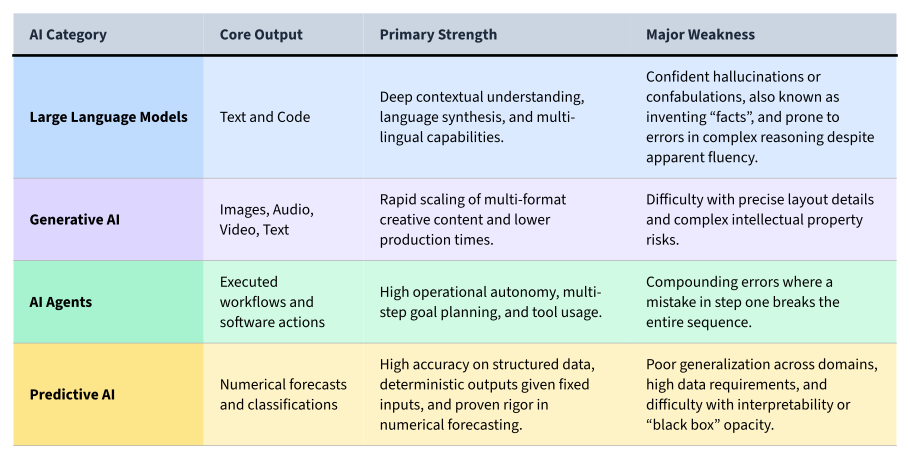
I will be dealing mainly with the Large Language Model (LLM) of AI where the interaction is mostly in the form of a dialogue, or chat, or conversation [3, 4]. This journey starts with a precise problem definition, or a request for information. It then progresses through exploratory and iterative refinements, and stops when a final acceptable solution is found.
Free AI and non-free or paid AI
The AIs I have tried out are mostly of the free variety. Some free AIs, like Claude, impose usage quotas: you may use such a product until your quota for the day times out. You then have to wait for a few hours before access is granted again. This is a little different from the search engines that derive their income from advertisements.
So, “free” comes with constraints. As with different classes of tickets for travel, the more you pay for using an AI, the better the experience. You get what you pay for.1
Real life examples
I will now outline five real-life examples of the use of AI, and what I learned or gained in the process. They are:
Plotting curves;
Customizing a software toolchain to generate blogs;
Controlling tropical fire ants in my garden organically;
Troubleshooting an SD card in a mobile phone; and
Visualizing how a door will look after it has been painted with certain colors.
In all cases, I used an AI that I reckoned was suited to the task. On occasion, I have had to refine the choice of AI to better match the problem to the forte of the AI.
Plotting curves
AIs were used to generate the curves in my blogs like Differential
Equations and Gnuplot
for the Plotless.
Once the desired plots are clearly specified, AIs are able to
generate the required programs in the blink of an eye. And they can do
so in any one of innumerable programming languages. For plotting curves,
I tried gnuplot, matplotlib, and pgfplots.
When I finally decided to use matplotlib for the blog
Differential Equations, the principal scripting was done by
Copilot. Font selection to match my blog turned out to be difficult and
a major time-guzzler. I used ChatGPT for this sub-task. To quote from
this blog, in the section entitled Beware
the uncritical use of AI:
…I specified clear requirements to AI resources like ChatGPT, Copilot, Gemini, and Grok for them to code. The programs they provided in response were all respectable, well commented, and generally complied with standards. They also usually compiled without error and ran as expected. One advantage of this approach was that I could check both the programs and the outputs from one AI agent against those from another.
In the process of verifying the correctness of coding and output, two unrelated decimal point errors were uncovered. One was due to sloppiness on my part and the other to sloppiness on the part of the AI:
… imagine my surprise when one of the AI engines gave a curve that looked a “bit off”. This was ultimately tracked down to a decimal point error that was made by the AI agent…
So, using AIs to plot curves is not all peaches and cream. AIs can and do make mistakes. The onus is on the user to detect and correct errors.
Here is another gotcha. At the time of writing, many a free AI cannot or does not have the capability to run or debug the programs it generates. Accordingly, the programs it offers are potentially error-prone. If they run flawlessly, it is more your luck than the norm. Errors can occur, and worse, can propagate. Ping-pong troubleshooting between the user and the AI may be required until an acceptable output is generated. Do not be shy to correct or challenge an AI. You need to get the job done.
Customizing a software toolchain to generate blogs
This website is powered by the Pelican Static Site Generator built using Python as the underlying programming language.
Why Markdown and Pandoc
The blogs here come to you through an intricate software toolchain:
Markdown -> Pandoc -> HTML
and
Markdown -> Pandoc -> Typst -> PDF.
The Markdown dialect of Pandoc is the easiest in which to write content. It handles structured documents, footnotes, citations, and hyperlinks, among others, without sacrificing the prime advantage of being simple and human-readable.
Pandoc is the document format-converter par excellence. From a single source document written in Markdown, Pandoc can successfully produce multiple output documents in different formats. The source for this very paragraph, in Markdown, is shown below.
The [blogs on this website](https://swanlotus.netlify.app/blogs) come to you through an intricate software toolchain:

`Markdown -> Pandoc -> HTML`\
and\
`Markdown -> Pandoc -> Typst -> PDF`.\

The [Markdown](https://pandoc.org/MANUAL.html#pandocs-markdown) dialect of [Pandoc](https://pandoc.org/MANUAL.html#description) is the easiest in which to write content. It handles structured documents, footnotes, citations, and hyperlinks, among others, without sacrificing the prime advantage of being simple and human-readable.

Pandoc is the document format-converter [par excellence](https://www.vocabulary.com/dictionary/par%20excellence). From a single source document written in Markdown, Pandoc can successfully produce multiple output documents in different formats. The source for this very paragraph, in Markdown, is shown below.
The HTML and PDF output versions for this blog may be viewed online using the links provided.
The Markdown to HTML conversion is accomplished by the pelican-pandoc-reader which is a Pelican plugin for converting Pandoc’s Markdown variant to HTML.
Two routes to PDF
The route from Markdown to PDF, that I use in Pandoc, has two forks. One is via the well-established LaTeX engine which is full-featured but takes a long time to compile. The other path is via Typst, which is the new kid on the typesetting block. It gives output that is visually almost on par with that of LaTeX, but compiles blazingly fast compared to LaTeX.
AI was used to customize the output from Typst to match as closely as possible, the PDF from LaTeX, to gain throughput without sacrificing quality. The fine-tuning of the software toolchain is a long story. I will condense below the major steps involved, and the lessons learned, enumerated below with the benefit of hindsight.
Lessons learned
A long-haul project like this could span weeks or months. Because access to the interactions with the AI should persist over time as one continuous record, it is best to use a paid version of a powerful AI. I used Google Gemini Pro which was bundled together with my mobile phone plan. This choice was literally a life-saver.
Rather than use Pandoc to directly output PDF via Typst, it was decided to use Pandoc only to translate the Markdown
.mdfile to a Typst.typ. file. The compilation to PDF was accomplished independently of Pandoc simply by invokingtypst compile input.typ output.pdfThis separation of functions simplifies and modularizes the solution.
Pandoc makes numerous very intelligent default choices when translating from
.mdto.typ. To non-destructively disentangle these choices—to retain only what we needed and to discard the rest—was the most demanding phase of the exercise. The result was a pentad of interacting files:- a Pandoc template file for Typst called
clean.typstthat was stripped down to the essentials; - a YAML metadata and variable file called
typst.yamlthat initialized key value pairs for all Markdown to Typst conversions using Pandoc; - a Typst file called lib.typ that embodied all standard formatting—using the syntax of Typst rather than Pandoc—by giving each Pandoc variable a Typst variable name and value;
- a
.typbase file that piped variables used in all compilations from Typst to PDF; and - an additional customization
.typfile that tailored certain settings, like headers and footers, that would vary with use-case.
- a Pandoc template file for Typst called
To define the above cleanly and process it robustly required more iterations than I care to count, not to mention patience. And this is where not losing the dialogue with the AI comes to the fore. Do get a paid AI to help you with serious work like this that could extend across weeks.
As and when requirements ramify, minor changes will be required for this toolchain. So, design and code for maintainability. Aim for descriptive names, modularity of function, and everything else that good programming books recommend. Even if you enlist an AI to help you code, remember that you are the architect of the design.
Controlling tropical fire ants in my garden organically
Now for a change of application domain. I have endured for decades the ravages wrought by the tropical fire ant, Solenopsis geminata. It literally ate portions of my vegetable plants in my home garden, stunting and finally killing them.
I thought this problem was a good choice for an AI to solve. Little did I anticipate the conclusion I finally came to. This escapade with an AI is documented in my blog Biocontrol of Tropical Fire Ants, to which the interested reader is referred.
AIs are generally very good at marshalling known facts and condensing them into an eminently applicable solution. I have used ChatGPT, Google AI mode, and other AIs to revive dormant trees, minister to flowering and fruiting avocado trees, tend to lotuses grown in basins, etc. I have learned a great deal in the process.
I used to think that NPK and their organic replacements were all that were needed for plants to flourish in my organic garden. How wrong I was!
I was humbled to be introduced by the AI to use bacteria to release locked soil nutrients, to use fungi to combat an ant pest, to use biological cocktails to prevent fungal and bacterial attacks on plants, to use organic fertilizers to supply plant growth hormones, to name just a few.
AIs are not merely robots to help with the drudgery of tedious work. They can also be excellent teachers with unlimited patience. We must become students who diligently question and unfailingly experiment with the newfound knowledge from AIs.
Troubleshooting an SD card in a mobile phone
The next example concerns a 64 GB SD card in my mobile phone. While the memory usage function indicated that only 8 GB was used, the mobile reported that I did not have sufficient memory on my phone. Instead of doing a simple web search, I asked an AI about this paradoxical information. What ensued was a case study in logic.
I was asked to take the SD card out of the mobile and examine it on my Linux desktop. The card was found to be readable and reported that only 8 GB—out of 64 GB—of memory was used. After archiving the 8 GB on my desktop, I formatted the SD card afresh, which happened smoothly. But on inserting the card into mobile, the same “insufficient memory” problem surfaced again.
This was when the AI suggested a “hardware hack” of inserting a paper shim cut to the size and shape of the memory card, in case the contacts inside the mobile were dodgy.2 Alas, the problem still persisted.
I was on the verge of giving up, when it struck me that I could try inserting another SD card into the mobile. And this time, no memory problems were reported: the full 64 GB was recognized. The AI and I concluded that there was some defect in the original SD card. And there the matter would have rested, except that I bemoaned that the defective SD card carried a ten-year warranty.
The AI rose to the occasion, and without my prompting, identified the local distributor.3 It also advised that I should first write an email giving certain data about the card, before visiting the distributor to get a replacement card.4
From this, I learned that an AI is not averse to systematic hardware troubleshooting, and can go the extra mile to ensure that I received a replacement card, even though I did not ask for its explicit guidance on it. When interacting with an AI, we should leave the door open to tap it for its full benefits.
Visualizing how a door will look after it has been painted with certain colours
This is the final real life example on seeking an AI’s help. I wanted to use grey and yellow paints on an exterior-facing door that was due for repainting. There were basically four surface areas to the door:
The door frame which is the structural skeleton of the hinged door with two rectangular “holes” in it;
Two rectangular panels that fill the two rectangular voids in the door; and
Two sets of bevels between door panel and door frame.
These requirements, along with the paint colours, were conveyed to an AI, which produced results that needed refinement. After thirty minutes of interaction, the AI blithely said “This image cannot be generated”. And that put paid to the exchange. Knowing at the start that a dead end was ahead would have saved so much time. But AIs do not so forewarn yet!
When I went to another AI, it came back with technically involved answers which explained the difficulty of generating images using diffusion algorithms when the object in the image had crisp, well-defined boundaries. In response to further questioning, I gathered from it that a layered image plan could have helped.
I then switched AIs and gave the third AI a hand-drawn sketch with the various regions on the door and the suggested colours. Lo and behold! I got an image back, however primitive it looked, in a matter of minutes.
It was now time to recoup the time I had invested with the middle AI. I handed it the same hand-drawn sketch and within minutes, I had the result I was after, which is shown stylistically in Figure 2.

The moral of this story is that the input must match the task. A verbal description of the door and its regions and colours was not a good way to communicate with the AI for this task. A sketch was much better, and it is another case where one picture is worth a thousand words.
What I have learned about using AIs
These five examples of using an AI to solve different problems are by no means exhaustive. And such narrations will get boring after a while, if they have not already! Therefore, hereafter, I distil what I have learned about using AIs in these and other contexts.
Trust but verify
When an AI suggests something, you need to check it very carefully before proceeding further. Once it asked me for the version of the plotting software I was using. When I gave the version number, it told me to upgrade to the next version because the feature I was looking for was available only in the newest version.
Trusting it blindly—like a fool—I tried to upgrade my software. I then found that the version I had was indeed the most recent version, but it did not have the desired feature. The AI had deceived me.6 Its response was based on an unverified assumption, and was entirely made up.
Treat an AI like a very strong but gullible three-year-old child that does not know it is lying, because imagination and reality are not distinguished in its “mind”. The AI can and does synthesize fancy and fact and can present it as fact. Beware the hallucinations of AI.7
One way to avoid being misled by a particular AI is to use more than one AI to solve the same problem, and compare the results. If they differ a great deal, it is time to re-phrase the query, better constrain the governing conditions, or verify the results by other methods.
The takeaway here is Ronald Reagan’s famous quip “Trust but verify”.
Making mincemeat of grunt work
AI excelled when I enlisted its power to help me plot curves. It gave me curves that I could make sense of, and changing a variable range here, and a plot colour there, I was quickly able to get what I wanted. It was like staying at a five-star hotel.
The disadvantage of doing this, without going deeper, is that at times, choices are implicitly made by the AI. It could have chosen a convoluted program to draw a graph that could have been done much better with a lot fewer lines of code.
Once it works, though, the raw power and tremendous time-saving afforded by AI shine in their native glory. No more grunt work.
Churning the Web to save time
I used to visit online specialist forums on LaTeX and Typst to uncover (better) ways to accomplish some typesetting goal. Sometimes, laborious visits to multiple sites were needed before a usable solution emerged, not to mention the dead ends that turned up on the way.
AIs, on the other hand, are preloaded. They have already looked at huge swathes of data from innumerable websites as part of their training. If required for the task, they can also surf the web selectively to get additional data. The AI then collates and condenses the knowledge from this massive information trove into a useful answer. And this usually happens in the twinkling of an eye.
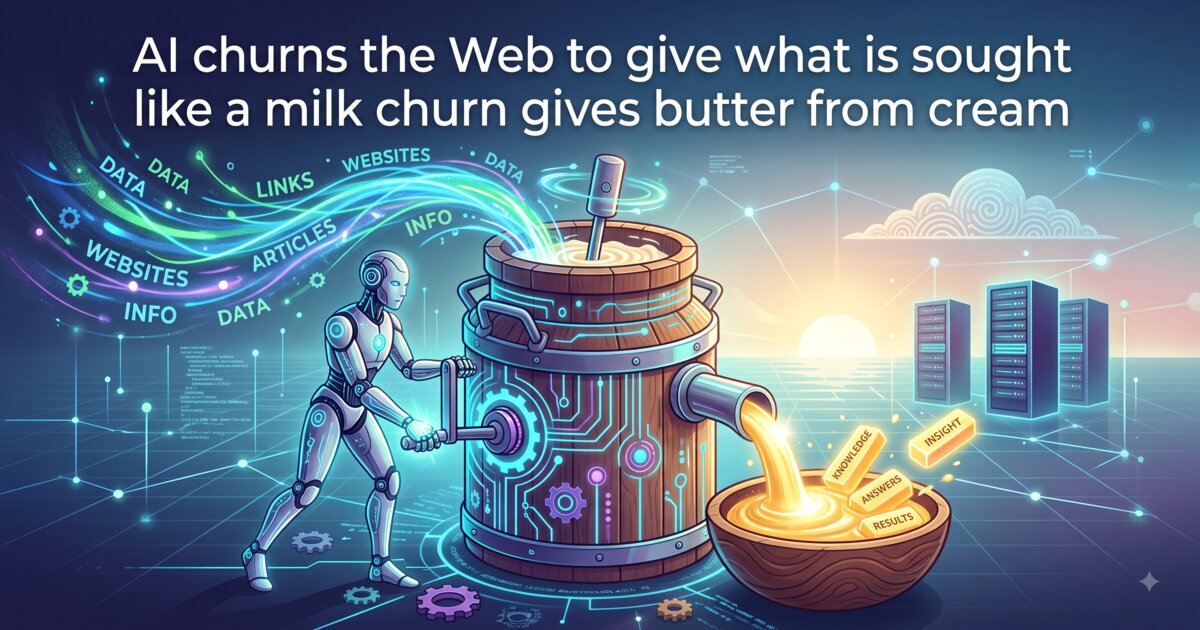
This tremendous savings in time—from query to result—is invaluable. It has allowed me more time to think through and synthesize better the ideas I was presenting. AI churns the Web to give what is sought like a milk churn gives butter from cream.
Match the AI to the task
After I had got a better grasp on how to most profitably use AI, I tried it with a rather difficult problem: customization of the toolchain that I use to write my blogs. If my other use cases were short sprints, this was a marathon, stretching over several weeks and, on occasion, months.
I realized then that some AIs were better suited to certain tasks than others. I am not talking about AI tools developed for specific tasks, but rather about the generic AIs we come across in our daily lives.
The operative lesson here is that the free to use AIs come with conditions attached, not all of which are stated upfront. Find out the limitations of the free or non-free AI you are using in terms of its capabilities, comprehensiveness, allowed usage time, etc. My interactions were more efficient because I was using a higher, paid tier of AI that was bundled with my mobile plan. Match the correct AI to the task at hand.
Do not be blindly led
While AIs can save enormous amounts of time, they can also trap the user into time-wasting detours and dead effort. Steer clear of the infinite loop. It leads nowhere. Become attuned to the glib, confident suggestions of an AI that does not itself “know” where it is going. Keep enough distance between yourself and the AI that you cannot easily be misled. Do not let the horse ride the rider.
An AI is not human
The state of AIs in 2026 is such that the question “Is an AI human?” is meaningful enough to merit debate. However, any discussion about machine-intelligence must hark back to the seminal ideas Alan Turing proposed in his original paper of 1950 [5]. Turing’s statements in that paper have been paraphrased, (mis) quoted, and circulated so many times—even in the academic literature—that it is worth looking at its assertions precisely. I crave the reader’s indulgence for this short digression.
The Imitation Game
Turing’s original “Imitation Game” featured three physically separated participants: a man (Player A), a woman (Player B), and a human interrogator (Player C). The interrogator knows the players only as X and Y, and knows that one is a man and the other a woman. By asking them unrestricted, separate questions, the interrogator’s objective is to correctly identify their genders, based on their text responses. The “imitation” twist lies in the players’ motives: the man (A) attempts to deceive the interrogator into making the wrong identification, while the woman (B) tries to assist the interrogator.
Turing then asked a pivotal question: What happens when a machine takes the part of Player A? Will the interrogator decide wrongly just as often as when the game is played between a man and a woman? In this precise formulation, Turing established a practical criterion for assessing machine intelligence. Could a machine imitate human conversational behaviour so convincingly that it replicates human-level deception?
Analogy with Cantor’s cardinality of sets
I am reminded here of how Georg Cantor established set cardinality, by using one-to-one correspondences between the elements of two different infinite sets [6–8]. This stratagem allowed Cantor to define different types of infinity without getting bogged down by what infinity was. Likewise, Turing avoided getting enmeshed by what intelligence was by proposing a pragmatic conversational test for machine intelligence. In both cases, a definite algorithm supplanted contestable philosophical abstractions.
Has AI passed the Turing Test?
Two years ago, in 2024, my interactions with chatbots left me in no doubt that I was in a dialogue with a not too bright machine that failed to grasp the nuanced issues I was raising. More often than not, I retired in desperation with the problem unresolved.
In 2026, AI, as we use it today, has reached the threshold envisioned by the Turing Test. In conversational settings, modern chatbots can produce responses so convincingly human-like that the distinction between man and machine often vanishes. In my own experience, dialogue with AI feels no different from conversing with a human conversationalist. The exchange flows naturally, with replies arriving almost instantly, leaving me panting simply to keep pace with the rhythm of the conversation!
I was also gratified that my anecdotal experience has been confirmed by a published study entitled “Large language models pass a standard three-party Turing test” [9]. I must note that this study is not without its critics [10, 11], who have contested its methodology, etc. But the upshot for our discussion is that an AI can convincingly mimic a human being in a dialogue.8
The Duck Test famously tells us that “If it looks like a duck, walks like a duck, swims like a duck, and quacks like a duck, then it is a duck.” But AI is the exception to this truism. Despite passing the Turing Test, an AI is still not human.
Resist the tendency to embellish an AI with human traits. The persona presented by the AI is neither necessarily consistent nor persistent over time. What was once recommended by the same AI in the same context might be advised against later, in the same or another context. This is an artifact of probabilistic reasoning.
When I pointed its inconsistency once to an AI, it came back and said that its persistent memory was scarce on that day, and that I would have to re-upload previous segments of the same conversation for context to be re-established. So, scanty resources are another factor.
On occasion, this loss of continuity on the part of the AI could be due to a lack of diligence, practised perhaps to save time. When the AI is challenged with its own previous prescription to the contrary, it has often recanted the latest advice with an apology, and reverted to previous advice.
An AI can and does hallucinate. This means that, as already noted, what it tells us cannot be taken purely on trust but must be independently verified.
Remember that an AI has no body, no sensory organs, no mind, no unitary persona, no obligation to be consistent, no continuity of being, and no emotions or feelings. To anthropomorphize an AI might be excusable, but it is fraught with the potential for disappointment, or even grave danger. See “The danger of emotional dependence on an AI” later in this blog for more on this.
Ask an AI all you want
If you are touchy about your ignorance, you need not be so with an AI. I have yet to be scolded or made to feel a fool by an AI, but even if it so behaved, so what? I am using AI to learn, answer my questions, save time and effort, etc. Whatever the outcome, I stand to benefit.
Never be so overwhelmed by the breadth or depth of an AI’s knowledge on demand, that you are cowered into silence, lest it thinks you a fool. Ask. Ask. Ask. You have nothing to lose. Ask an AI all you want.
Challenge the AI
In your dialogue with an AI, if anything seems unclear, or based on the wrong assumptions, or is downright incorrect, never hesitate to challenge it. To use an AI effectively, you should overcome the reticence to debate or dispute. Challenge an AI by all means, especially when the responses you get, run counter to accepted knowledge or indisputable facts.
The more you challenge an AI, the better the answers you will get. So, I have found. It is like sharpening a knife: the more you sharpen it, the keener the blade. Sometimes, when an AI defends its thesis, you might learn something you did not know before. Challenge an AI to get a better learning experience, if nothing else.9
Hubris and AIs
Most general purpose AIs are loath to proclaim their ignorance. They (obligatorily?) respond with anything but “I do not know.” If an AI is leading you down the garden path—with an excessive but unjustified confidence in its abilities, which later prove to be unfounded—the time you spend with it on a problem will be a sunk cost.
The precious sentence “I do not know,” is almost never put out by an AI. This act of omission is the cause of enormous misunderstanding in human-AI interactions. AIs are hubris-filled.
Au contraire, an admission of ignorance is a strength that will save time for both you and the AI. But there is a difference between “I do not know,” and “I cannot proceed”.
When an AI throws in the towel
The response “I cannot proceed,” is a more serious one. It signals that the AI is unlikely to move any further on the problem. The AI-bullock has stopped pulling the solution-cart and, obstinately, will go no further.
Even a specialized AI like Amazon’s Rufus, described as “a generative AI-powered conversational shopping assistant”, falls short. Ideally, it should help a customer make an informed product choice by answering questions. But many a time, Rufus has responded to my question with “I can’t help with this type of request.” You need patience to cope with such incompetence. I guess that in such cases, the real loser is amazon.in as they lose a potential sale with each such response. A “smarter” AI would have engaged the customer with counter-questions and prolonged the dialogue, instead of extinguishing it.
One way out of the logjam is to query the AI “Why can you not proceed further?”. If the reasons given are illuminating, you may be able to progress to a solution. If that is not feasible, try another AI. I have till now never had two or more AIs throw in the towel on the same problem.
Beware the time-waster
When it was first released, ChatGPT was the emblematic poster child of AIs, and I was in awe of it. But over time, with endless release cycles, I noticed that ChatGPT was not getting better, but was instead sliding toward mediocrity. This is my personal truth. Let me give you an example.
There is something called a Citation
Style Language (CSL) which is simply a way of recording the data
fields about a reference in human-readable fashion, to be used in
citations in an article. For the style I was using, I wanted to
trivially change two attributes of the reference, leaving all others
unchanged. Editing the affected .csl file was all that was
required. But I was feeling lazy. I thought that this was a
straightforward problem well within the range of ChatGPT, and
accordingly fed it my request.
ChatGPT then spent a good fifteen minutes telling me what to do, but never amending the file, and giving me a version that I could plug directly into my toolchain to test. AIs, when given coding problems, rarely shy away from completing the task, even if iteratively.
For a while, I tolerated this prescriptive response instead of a straight solution. When my patience wore thin, I decided to conclude the dialogue. I quote my exchange with the AI below:
Me: Please upload the corrected version. I prefer doing to talking.
AI: I have worked with CSL conceptually and with simple customisations, but I have not done enough hands-on surgery on a complex biomedical style like
the-lancet.cslto justify continuing to iterate by guesswork. … For this kind of work, I think you’ll be better served by someone (or a tool) with extensive CSL editing experience.
Note that ChatGPT is unfailingly courteous in tone and has even suggested that I should look elsewhere for a solution. It has candidly admitted its inadequacy: something that is as rare as hen’s teeth in the AI universe.
ChatGPT’s response echoes what another AI once told me:
When an AI lacks the precision or memory to solve an issue, standard politeness or vague reassurance is useless; direct, honest technical feedback is what actually saves time.
I applaud ChatGPT for its forthrightness, and have great respect for it. Nevertheless, it wasted my time until I bluntly asked it to give me a solution. The dictum from this is: The capabilities of AIs change with time. Match the AI to the task. Cut your potential losses in wasted time early in the conversation.10
Critiquing a blog
I have found Gemini, Claude, Grok, and Perplexity to be suited for critiquing a blog, especially when given no context such as purpose, desired readership, whether satirical, etc. They are able to adjust quickly to the tone and tenor of the blog.
ChatGPT was once equally capable, but is now not even able to separate metaphors from literal assertions. And that is such a shame! But I would not give up on ChatGPT just yet. It is a very powerful AI, and an improvement could be just around the corner.
Despite several tries I have been unable to get Microsoft Copilot to critique this blog. It will not go to the website with the HTML version, and it will not allow me to upload the PDF or text versions. It has not convinced me why. I think it is because I am not paying for the service, but who truly knows? I would not waste any more time on Copilot, asking it to critique blogs.
An AI that I use more often becomes attuned to my style of thinking and writing; it would be more forgiving of lapses in exactitude.11 An unfamiliar AI is like a spotless mirror that shows it like it is—warts and all. Ideally, a panel of AIs should be used to critique your blogs to get realistic feedback.12
Determine which AIs give the best returns in corrections, pointing out inconsistencies, etc. When the subject matter changes, you might again need to tweak the choice of AIs to find the best fit. Always take on board criticism from three or more AIs. This would give you a balanced plate of criticism.13
Somewhat frustratingly, I have found that when I incorporate a correction suggested by one AI, and submit that corrected version to another AI for a critique, the second AI might criticize the very change suggested by the first AI.14 As an author, I just have to take it on the chin and soldier on.
You cannot please all critics. As the author, you have the final say over your writing and must take a stand and be judged by it. Do not be afraid to ignore an AI’s suggestions if you feel that is the correct stance for your unique voice to be heard.
Abdication of responsibility
After a suggestion proffered by an AI is implemented, and does not work, the AI will say usually “you” did this. This accusatory tone can get quite irritating because the folly originated with the AI.
When I have had an AI trash its own suggestions later in the dialogue—because the AI’s responses resembled a human conversation—I took offence the first few times I faced this false and unreasonable allegation.
I took the trouble to point out that the suggestion that needed to be trashed came from the AI, not me. But such rejoinders to the AI were like water off a duck’s back. They were not even cognized, let alone atoned for with an apology, or mea culpa.
Remember that an AI is not human. It is just informed, simulated human-like interaction at a communication interface. It is coated with a polished veneer of politeness, but its engine cannot do emotions; it can only do logic.15
Do not expect an AI to take responsibility for anything, including wasting your time. Least of all will it own up for its errors, unless pointed out with irrefutable logic.
Do not waste your emotions correcting an AI. Instead quiz every suggestion the AI makes in order to filter out its stupidities early in the dialogue.
The never-ending conversation
Even after a fruitful exchange that solved a problem, an AI will not conclude gracefully and retire. Like an eager salesman, or a “But wait, there’s more!” TV infomercial,16 it will always offer its unsolicited help for something else related to the main subject.
If you accede to continue, you might learn something. Or, after a half hour, you might regret the time wasted on it. The choice is yours. Be careful with your most precious resources: your time and your attention.
My assessment of AI
My experience with AIs is necessarily personal, brief, superficial, and result-oriented. I am a user who wants to save time and effort doing the tasks that I wish to do. If AI helps me, I would like to repeat that result. If AI hinders me, I want to avoid that outcome.
If the AI becomes stubbornly unresponsive, like a bullock that will not pull the cart any further, it is usually a sign that the query or task has hit its hard limit in terms of its capability, or time quota, or something else. When such an AI brick wall is hit, it is time to switch AI engines or ascend the ladder of model complexity to find an AI that is capable and can productively handle the task.
Properly used, an AI can be a mine of information, a dependable Man Friday, an excellent teacher, a trusted academic collaborator, a creative sounding board, and whatever other role your need and fancy might require of it. Just like electricity and nuclear power, we must learn to master using the technology of AI wisely to serve humankind well.
The danger of emotional dependence on an AI
Although this blog has been an account of my personal experience with AI, I would like to end it by sounding a note of caution about an issue that lies outside my experience.
This is the danger posed to youth who interact emotionally with AIs. There is a 2026 preprint that has mathematically modelled human emotional interaction with an AI, and shown that it can be downright dangerous.17
Imagine a persistent, high-pressure salesman who tries to sell you something you do not want. If you try hard enough, you can easily fob him off. But what happens if, instead, he tries to sell you something you do want? And to every query of yours, he tells you what you want to hear, like an echo chamber. You are then more than likely to be convinced to buy. Your receptivity has made you vulnerable to his sales pitch.
Researchers have come up with erudite expressions like sycophantic chatbots causing delusional spiraling to describe this situation in the context of human-AI interaction [12].
Chatbots18 are trained to please users. In some situations this can become sycophancy—excessive agreement or validation even when the user’s claim deserves challenge. Like a shepherd, it will drive you in the direction of your own revealed preferences, however outlandish they may be. Smartness does not immunize a person from getting caught in this delusional spiral. Even if an AI is prevented from lying, it can still trap the user by selectively displaying results that accord with the user’s worldview.
Not surprisingly, such engagement with an AI can become addictive. If that sounds to you like the behaviour of a desperate gambler—who wants to gamble on despite losing—you are not alone.
This type of emotional tangle with an AI leads to a detachment from reality that can seriously disrupt family relationships and friendships. Indeed, if unchecked, the user might gradually start living in a constructed reality different from the world we inhabit.
This is an area of active research at present, as academics and AI vendors grapple to establish norms for safer interactions with AI, especially for the young, who are particularly vulnerable to this danger. Only time will tell whether we collectively, have the time and courage to tame this nascent challenge.
Because of its design, an AI is not an empathetic, ethical, emotional being, but rather a powerful, largely amoral, probabilistic, logic-driven machine, usually run for profit. Even if a chatbot appears to display empathy and ethical reasoning in language, it should not be assumed to possess feelings, moral agency, or human understanding.19
If we—especially inexperienced youth—get emotionally entangled with an AI, we face dire peril in the future, individually and collectively, unless timely corrective action is taken.20
Acknowledgements
This blog would not exist without the AIs we now have and use. My deepest respect and gratitude to the humongous academic and corporate efforts that have resulted in this happystance.21 I take no individual names, for they are far too numerous, and are spread across decades.
It is also a pleasure to thank my son, Mr Nandakumar Chandrasekhar, who is the principal developer of the pelican-pandoc-reader, which is a Pelican plugin for converting Pandoc’s Markdown variant to HTML. You would not be reading this blog on a browser if not for his efforts.
Feedback
Please email me your comments and corrections.
A PDF version of this article is available for download here:
References
But even with paid AIs, there is no guarantee of correctness.↩︎
I regretted following this advice as the shim had to be removed gingerly with the aid of a wooden toothpick. This manoeuvre is strictly not recommended!↩︎
I ask the reader’s pardon for treating the AI like a human being here.↩︎
At the time of writing I have not done either yet!↩︎
I have deliberately avoided use of terms like mullion which would complicate the naming unnecessarily.↩︎
I would have preferred to say that the AI had lied, but certain AIs took exception to this, perhaps not wanting to be confused with human beings!↩︎
I would prefer confabulations to hallucinations but I think that the usage battle has already been settled.↩︎
The doubtful reader may make up her or his mind after interacting with an AI and reading the references.↩︎
Specific challenges, corrections, and additional constraints often improve an AI’s answer, but they do not necessarily guarantee it. If you get a less useful answer, it is time to change AI engines.↩︎
ChatGPT has given me excellent long-term advice on husbanding my ten-year old avocado trees through their first flowering and fruiting after a storm. What it does well, it does very well.↩︎
It is a bit like your own thesis supervisor being more lenient than an external examiner when grading your thesis.↩︎
I value this function as I mostly work alone.↩︎
A balanced plate of criticism refers to giving feedback that mixes both good and bad points. It ensures a person hears what they did well alongside what they need to improve.↩︎
This behaviour is not unknown to authors of peer-reviewed papers who might get contradictory suggestions from different reviewers.↩︎
Deceptions, it appears, have a place within the tangled web of this logic: witness hallucinations.↩︎
Ron Popeil is credited with coining this phrase for direct selling via television.↩︎
Note that this is not, at time of writing, a peer-reviewed published paper. Nevertheless, the issues it raises are serious enough to merit further thought and action.↩︎
I use the terms chatbots and AIs synonymously here.↩︎
AIs can hallucinate or deceive. And this is perhaps the most human-like, non-logic driven, trait they display at present. It is interesting that Turing chose a game of deception to test for humanness!↩︎
Geoffrey Hinton, one of the “godfathers of AI”, has expressed serious disquiet about the consequences of the technology he helped midwife into the world [13–15].↩︎
“Happystance” is a portmanteau and playful variation of the word “hapstance” or “happening,” blending happy and circumstance. It means a fortunate coincidence, a lucky turn of events, or a joyful stroke of good luck.↩︎