The Dearness Code
2026-05-17 | 2026-06-04
Estimated Reading Time: 30 minutes
This is a philosophical blog that is longer than a usual blog, but shorter than a slog like Varieties of Multiplication. A TL;DR would help a reader to decide whether or not to read it in full. Accordingly, here are the bare bones of the discourse:
TL;DR
The sage Yājñavalkya’s revelation to his wife Maitreyī in the Bṛhadāraṇyaka Upaniṣad may be summarized so:
People and things are dear because they reflect or connect us to something deeper.
That deeper something is ultimately our own Self, or Ātman.
When we realize the Self in all things, everything becomes dear.
This realization is not intellectual but experiential—like salt dissolving in water.
A chance meeting with Sol
My bosom friend, Solus “Sol” Simkin, unexpectedly turned up at a seminar I was attending one afternoon. We had not seen each other for almost three months, and the chance encounter was most gratifying. Having made eye contact, we tacitly agreed to walk and talk after the seminar was over.
And that was when I said, “Sol, I had not realized how precious you are to me. We haven’t met for a dozen weeks now, and I would normally have thought nothing of it, busy as both of us are. But the moment I laid my eyes upon you, all the warm emotions came tumbling into my heart. It might sound a little schmaltzy, but I must tell you how literally dear you are to me.”
Sol’s eyes gleamed at my admission, but he was far too reserved to express reciprocal feelings. Instead, he asked me, “What is it that makes someone or something dear? Is it wealth, or utility, or relationship, or an indecipherable longing, or something else entirely? Have you ever thought of that?”
“Let us spend the little time we have together before dusk, to enjoy the shift in the rhythm of the world, as day melds into night. The ponderous, cerebral question you just asked me can wait for another day,” I replied.
“Quite so,” replied Sol as we strode briskly, enjoying the animated birdsong that celebrates the passing of every day, as light turns to dark.
“May I insist, however, that we return to the question of dearness when we meet next,” Sol said as we walked in silent eloquence, enjoying each other’s company.
We met again three weeks later, on a crisp and sunny morning, to resume our discussion on dearness. This time, I was the dominant conversationalist, with Sol voicing only short interjections or questions.1
The scriptures of Sanātana Dharma
I started off by saying “What makes something dear is the nucleus of a celebrated dialogue in the scriptures of India. First, a bit of context.
“The four Vedas provide the foundation for Sanātana Dharma, commonly known as Hinduism. The Upaniṣads comprise the concluding portion of the Vedas, and provide the philosophical basis for the way of life enjoined by Sanātana Dharma.
“Interestingly, the Upaniṣads generally assume the Question-and-Answer (Q & A) format, suggestive of contemporary forums on the Web. Typically, a student will ask an earnest philosophical question of his or her guide, who is often a Ṛṣi,2 or seer of Truth. The latter will answer. That answer will spawn more questions, and so on and so forth.
“The initial question thus generates a dialogue in which the issue is dissected anatomically, with the Q & A volley going back and forth, as in an intense ping-pong match. The dialogue resolves into silence when a statement of finality is reached. For those in the know—the pundits—the denouement can be as exciting as the conclusion of a mystery thriller, or a riveting sports match.”
Sol took it all in with rapt attention.
The Yājñavalkya-Maitreyī Dialogue
“I now come to the subject under discussion”, I resumed.
“Yājñavalkya was a towering Vedic spiritual figure, and one of the most celebrated Ṛṣis of Sanātana Dharma. The Vedas have preserved many of his utterances in various books. Among these is the Bṛhadāraṇyaka Upaniṣad [1–6].3 It is the oldest and largest of the Upaniṣads, and lays the foundation for a unique and unitary view of the world.
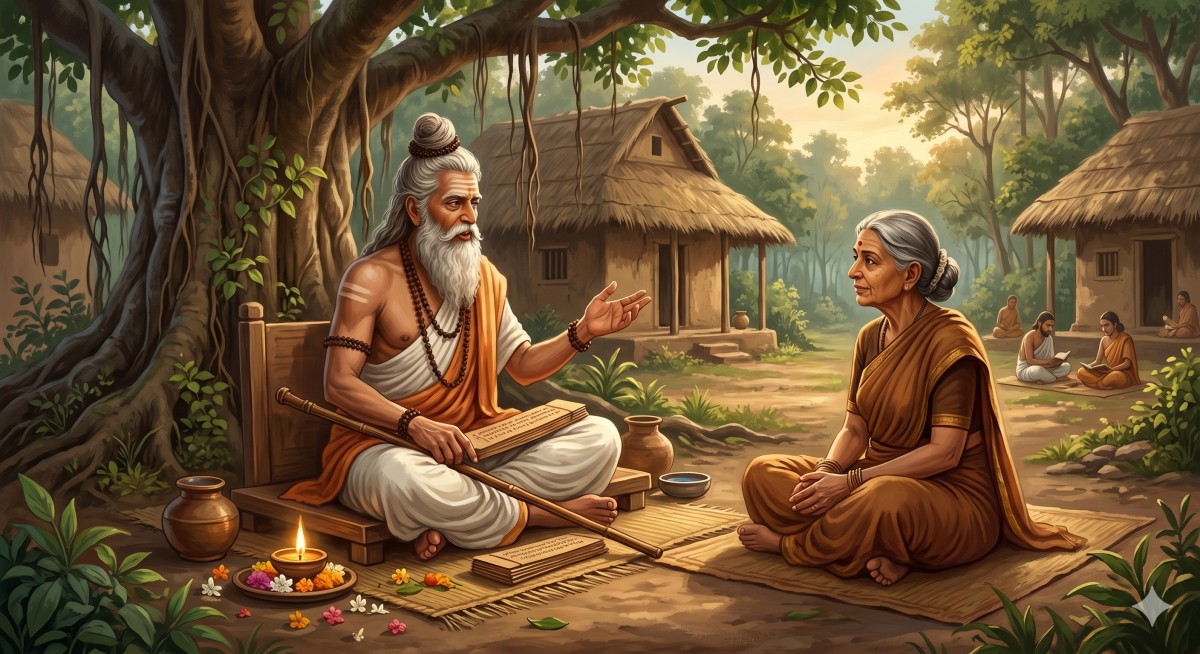
“The Bṛhadāraṇyaka Upaniṣad (2:4) features one of the most profound dialogues between two people. The questioner is the contemplatively inclined Maitreyī, one of the two wives of Yājñavalkya. The person answering is, of course, our illustrious sage.
The Prologue
“Yājñavalkya starts out [6] by declaring that he would like to renounce the world. Thus, he wishes to divide his estate between his two wives, so that they would be catered for after his departure from the role of householder and provider.4
maitreyīti hovāca yājñavalkyaḥ, udyāsyanvā are’hamasmātsthānādasmi, hanta te’nayā kātyāyanyāntaṃ karavāṇīti ॥ 1 ॥
‘Maitreyī, my dear,’ said Yājñavalkya, ‘I am going to renounce this life.’ Allow me to settle between you and Kātyāyanī.5 (1)
“The introspective Maitreyī immediately asks whether wealth would confer immortality on her:
sa hovāca maitreyī, yannu ma iyaṃ bhagoḥ sarvā pṛthivī vittena pūrṇā syātkathaṃ tenāmṛtā syāmiti; neti hovāca yājñavalkyaḥ, yathaivopakaraṇavatāṃ jīvitaṃ tathaiva te jīvitaṃ syāt, amṛtatvasya tu nāśāsti vitteneti ॥ 2 ॥
Thereupon Maitreyī said, ‘Sir, if indeed this whole earth full of wealth be mine, shall I be immortal through that?’ ‘No,’ replied Yājñavalkya, ‘your life will be just like that of people who have plenty of things, but there is no hope of immortality through wealth.’ (2)
“Wait a minute!” interjected Sol. “What has immortality got to do with the husband renouncing the world? The wife might be shocked by his sudden announcement. Very likely, she will miss him, and that could lead to the sorrow of parting or even grief. But immortality? No, I don’t buy it. If this is the way the dialogue single-steps its way, I think it feels contrived rather than an account of what really transpired.”
“I will answer you in two parts,” I replied. First, in the context of Sanātana Dharma, anything subject to changes like waxing and waning, gain and loss, marriage and separation, is considered mortal. Maitreyī’s relationship with Yājñavalkya is subject to the loss of separation, and therefore mortal.
Immortality, amṛtatva, is characterized by that which cannot be lost, because, by definition, it can never be unjoined from oneself. This is why Maitreyī goes straight for the jugular, which is immortality: that which cannot be lost and from which there can be no separation.
“If you find that contextual explanation a little hard to swallow, I think I can allay your doubts if I am granted a little literary licence, Sol,” I said. The loss of the husband’s companionship will leave a void in her life. But Maitreyī is an introvert. Like a Chess Grand Master, she has already started thinking several moves ahead.
“Her thought process could have run like this. My husband is dear to me and I will miss his presence. What is most dear to me after him? Is it my body? My mind? My existence?
“And here, I will crave your indulgence to make a small detour into Shakespeare-land.”
Maitreyī’s question and Shakespeare’s Macbeth
“In his plays, the bard often uses his characters—even minor ones—to make profound statements. In Macbeth, there is an exchange about how the Thane of Cawdor met his death that is relevant to our discussion. As Malcolm recounts it in Macbeth (I:4):”
…nothing in his life
Became him like the leaving it; he died
As one that had been studied in his death
To throw away the dearest thing he owed6
As ’twere a careless trifle.
“I fail to see how this is relevant to the Upanishadic dialogue under discussion,” interjected Sol.
“Patience, for a moment please, Sol,” I replied. “Bear in mind that this is merely my interpretation to justify the question asked by Maitreyī.
“Shakespeare is describing how the traitorous Thane of Cawdor faced his own death: bravely, without fear, and with dignity. He ‘[threw] away the dearest thing he owed (owned) as 'twere a careless trifle.’ The revelation here is that the dearest thing any of us owns is our own life.”
“I grant you that,” admitted Sol, perhaps a little hesitantly.
“Moreover,” I continued, “the Thane of Cawdor was renouncing his life itself, whereas Yājñavalkya was renouncing the householder’s life. Surely, the similarity does not escape you!
“This little excursion brings us back to Maitreyī and what she must have gone through in her mind: again I have taken artistic licence.”
The dearest thing
“Since she believed in the finality of Yājñavalkya’s resolve to renounce the world, Maitreyī immediately caught on to the ‘dearest thing’ she owned—her own life. If she could not forestall the absence of Yājñavalkya, at least could she aim for immortality?7 Was immortality the state that Yājñavalkya was hoping to attain by renouncing? Could she walk the same path?
“Like a flash of lightning, Maitreyī asks if Yājñavalkya’s wealth would confer immortality on her, to which Yājñavalkya, as we have seen, replies in the negative. And this is the start of a breathtaking volley of implied questions and answers on dearness that should thrill any philosopher or logician.”
Immortality and Dearness
“The dialogue continues thus:
sa hovāca maitreyī, yenāhaṃ nāmṛtā syāṃ kimahaṃ tena kuryām? yadeva bhagavānveda tadeva me brūhīti ।। 3 ।।
Then Maitreyī said, ‘What shall I do with that which will not make me immortal? Tell me, sir, of that alone which you know (to be the only means of immortality).’ (3)
“We have in Maitreyī an uncompromising seeker of the ultimate verity for whom no platitudinous dilutions of raw truth will suffice. She wants immortality, and implicitly, the means to attain it.
sa hovāca yājñavalkyaḥ, priyā batāre naḥ satī priyaṃ bhāṣase, ehi, āssva, vyākhyāsyāmi te, vyācakṣāṇasya tu me nididhyāsasveti ॥ 4 ॥
Yājñavalkya said, ‘My dear, you have been my beloved (even before), and you say what is after my heart. Come, take your seat, I will explain it to you. As I explain it, meditate (on its meaning).’ (4)
“Every teacher loves an earnest, eager, and engaged student, and Yājñavalkya is no exception. He calls Maitreyī ‘(especially) dear’ and this sets the tone for the dialogue on dearness. In keeping with the ardour of the student, his instruction is for her to contemplate on his words. It is no armchair philosophy, but one of active experiential exploration through solitary self-effort.
“Why does Yājñavalkya’s reply—to Maitreyī’s question about immortality—begin with a discussion of dearness?” asked Sol.
“Remember that Yājñavalkya and Maitreyī are on the same philosophical page. The exemplary student is worthy of her illustrious teacher. The implicit thoughts behind their words are mutually intuited and understood tacitly. Yājñavalkya asks what makes the husband-wife relationship so dear? Why does anyone want a husband, or a wife, or children, or wealth to be permanent? Because we are attached to them. And the question then becomes: what is the binding force, or gluon, behind all attachment to persons or things?
A hierarchy of dearness
“Verse 2:4.5 below embodies the kernel of this dialogue.
sa hovāca:
na vā are patyuḥ kāmāya patiḥ priyo bhavati, ātmanastu kāmāya patiḥ priyo bhavati ।
na vā are jāyāyai kāmāya jāyā priyā bhavati, ātmanastu kāmāya jāyā priyā bhavati ।
na vā are pūtrāṇāṃ kāmāya putrāḥ priyā bhavanti, ātmanastu kāmāya putrāḥ priyā bhavanti ।
na vā are vittasya kāmāya vittaṃ priyaṃ bhavati, ātmanastu kāmāya vittaṃ priyaṃ bhavati ।
na vā are brahmaṇaḥ kāmāya brahma priyaṃ bhavati, ātmanastu kāmāya brahma priyaṃ bhavati ।
na vā are kṣatrasya kāmāya kṣatraṃ priyaṃ bhavati, ātmanastu kāmāya kṣatraṃ priyaṃ bhavati ।
na vā are lokānāṃ kāmāya lokāḥ priyā bhavanti, ātmanastu kāmāya lokāḥ priyā
bhavanti ।
na vā are devānāṃ kāmāya devāḥ priyā bhavanti, ātmanastu kāmāya devāḥ priyā bhavanti ।
na vā are bhūtānāṃ kāmāya bhūtāni priyāṇi bhavanti, ātmanastu kāmāya bhūtāni priyāṇi bhavanti ।
na vā are sarvasya kāmāya sarvaṃ priyaṃ bhavati, ātmanastu kāmāya sarvaṃ priyaṃ bhavati ।
ātmā vā are draṣṭavyaḥ śrotavyo mantavyo nididhyāsitavyo maitreyi, ātmano vā are darśanena śravaṇena matyā vijñānenedaṃ sarvaṃ viditam ॥ 5 ॥
Yajnavalkya said:
Verily, not for the sake of the husband, my dear, is the husband loved, but he is loved for the sake of the Self.
Verily, not for the sake of the wife, my dear, is the wife loved, but she is loved for the sake of the Self.
Verily, not for the sake of the children, my dear, are the children loved, but they are loved for the sake of the Self.
Verily, not for the sake of wealth, my dear, is wealth loved, but it is loved for the sake of the Self.
Verily, not for the sake of the Brāhmaṇa, my dear, is the Brāhmaṇa loved, but he is loved for the sake of the Self.
Verily, not for the sake of the Kṣatriya, my dear, is the Kṣatriya loved, but he is loved for the sake of the Self.
Verily, not for the sake of the worlds, my dear, are the worlds loved, but they are loved for the sake of the Self.
Verily, not for the sake of the gods, my dear, are the gods loved, but they are loved for the sake of the Self.
Verily, not for the sake of the beings, my dear, are the beings loved, but they are loved for the sake of the Self.
Verily, not for the sake of the All, my dear, is the All loved, but it is loved for the sake of the Self.
The Self, my dear Maitreyī, should be realized—should be seen, heard of, reflected on, and meditated upon. By the realization of the Self, my dear, through seeing, hearing, reflection, and meditation, all this is known. (5)
“Two words merit clarification here. The word kāma is generally translated as desire. Here the word kāmāya has the sense for the sake of or for the fulfilment of.
“The word ātman, denoted by the capitalized word Self, is even more nuanced. The ātman is the irreducible quantum of awareness residing in the observer.8 We are not talking about deep sleep or anaesthesia, but about that complex without which a physical being becomes a corpse. What remains of that complex, after all outer layers are peeled, is the Self or ātman.
“The crucial distinction is that the ātman does not refer to the body-bound, sense-engaged ego, but to the pristine awareness that is encased in the body. The Self thus denotes both the universal unitary consciousness that pervades all Creation, and animates all beings, and also that same consciousness residing deep within each being.
“Yājñavalkya’s ladder of dearness spans from the near and the particular, to the distant and the general:
- family,
- wealth,
- social orders,
- cosmic planes,
- deities,
- beings/elemental forces,
- everything.
“Nothing has been left out.
“And in each case, he emphatically states that the object of dearness is dear not for its own sake, but for the sake of the Self.
The theorem on dearness
Yājñavalkya states his ‘theorem on dearness’:
na vā are sarvasya kāmāya sarvaṃ priyaṃ bhavati,
ātmanastu kāmāya sarvaṃ priyaṃ bhavati ।
Nobody loves anything for its own sake;
For the sake of the Self, everything is dear.
His final pronouncement is: ‘For the sake of the Self, everything is dear.’
‘For the sake of the Self, everything is dear.’
This is one of the most mathematically precise statements on how love arises and operates. Loosely stated:
“I love you because I am you. All creation is an elaboration of my own Self. There is no other.
“The centrality of the Self and the importance of knowing oneself are corollaries that follow from this theorem.
“Paradoxically, although the Self is closer than the skin and the heartbeat of the individual, to cognize it in oneself requires prolonged ‘seeing, hearing, reflection, and meditation’. This spiritual prescription is to be practised, says Yājñavalkya, until one realizes the Self.
“Yājñavalkya goads Maitreyī to put in the effort to transform the truth of what he has said into her own reality. It should not be mere knowledge that can be parroted, but an unshakable realization, founded on actual experience. This state does not come cheap, but when it does, the jackpot has been hit!9
“This exchange is so important that it is repeated substantially in Chapter 4 of the Bṛhadāraṇyaka Upaniṣad—a reiteration which happens but rarely in these terse texts.”
“Whew! That was one mouthful, or should I say brainful?” exclaimed Sol as I concluded my verbal account.
“I will now rest my narration from the Bṛhadāraṇyaka Upaniṣad, Sol,” I replied. “Your brain needs rest!”
But Sol had his rejoinder.
How can one become the many?
“All that has been spoken is doubtless very noble. But is it true? How can one become the many? How can my deepmost Self be the same as the deepmost Self of everything from stone to saint? I cannot accept that: it would violate some conservation laws at the very least!” declaimed Sol. “The hardest part for me to accept is that there is nothing else except my Self in all of Creation. For a start, if that were true, why do I not experience it?”
“We are all under a magical spell called māyā,” I clarified. “We human beings have drunk the potion of forgetfulness of who we really are. And so we flounder through life. Is that fair? It does not seem so. But yet, here we are, lollygagging our way through life, without so much as a clue about who or what we really are.
“Perhaps the most palatable analogy I know of is this: when we sleep and dream at night, we are totally engrossed in the dream and believe it to be true in every detail. It is only upon waking up that we effortlessly dissolve the dream and start experiencing our workaday world.10
“Yājñavalkya is egging Maitreyī on to awaken from the grand hypnosis of māyā that permeates our everyday reality. She would then automatically behold her own ātman in everything, and would have unlocked the dearness code at its very fount.”
“You have made a valiant effort at convincing me, but I still nurse within me serious doubts about what is taken as established truth,” Sol rebutted mournfully. “It is a bit fantabulous, to be honest.”
A lump of salt in water
“Yājñavalkya’s reply is cryptic and opaque to me,” said Sol. “I can follow his hierarchy of dearness and can relate to it. But how does that lead to literally everything being dear because of the Self? Where does the Self enter the discourse? I know that you have explained the Self by saying that upon death, the Self departs the body. What is this Self?”
“I hear you, Sol,” I said. “Great philosophical profundity is hidden within Yājñavalkya’s reply. Some principles from science as we know it today might give you a scaffolding on which to hang some plausibility arguments in this most arcane of discussions.
“Yājñavalkya has pre-empted your query and gives various analogies of how the one may be fused into the many. In succeeding verses, he uses drumbeats, conch sounds, the notes from the vina when its strings are plucked, smoke from fire, water in the ocean, etc., to illustrate the one-in-many idea. These examples might require contextual Vedic knowledge to be fully understood. But there is one final example that even a middle school student of today will understand. It is verse 2:4:12 of the Bṛhadāraṇyaka Upaniṣad:
sa yathā saindhavakhilya udake prāsta udakamevānuvilīyeta, na hāsyodgrahaṇāyeva syāt, yato yatastvādadīta lavaṇameva, evaṃ vā ara idaṃ mahadbhūtamanantamapāraṃ vijñānaghana eva ।
etebhyo bhūtebhyaḥ samutthāya tānyevānu vinaśyati, na pretya saṃjñāstītyare bravīmīti hovāca yājñavalkyaḥ ॥ 12 ॥
As a lump of salt dropped into water becomes dissolved in water and cannot be taken out again, but wherever we taste the water it tastes salty, even so, my dear, this great, endless, infinite Reality is Pure Intelligence alone.
This Self comes out as a separate entity from these elements, and with their destruction this separate existence also is destroyed. After attaining oneness it has no more (individual) consciousness. This is what I say, my dear. So said Yājñavalkya. (12) [7]
“The salt once dissolved in the water cannot be seen, but it can be tasted, and its existence in the brine may be inferred. There is also the disconcerting implication that once the salt is dissolved, it cannot be undissolved. It has become brine and ‘has no more (individual) consciousness’.
Yājñavalkya is precise in his terminology for distinguishing dualistic perception from non-dual awareness. He says that the Self is vijñānaghana—pure, homogenous mass of consciousness. Just as oxygen supports combustion, but is itself non-combustible, the Self, being consciousness, enables perception, but cannot itself be perceived, because there is no one else to perceive it.
Just as oxygen supports combustion, but is itself non-combustible, the Self, being consciousness, enables perception, but cannot itself be perceived, because there is no one else to perceive it.
Sol gave me a look of abject anguish after hearing all this. He was not one given kindly to the prospect of self-annihilation. I felt that I needed to console him.
“Take heart, Sol,” I said. “You are not alone in your consternation. The great Maitreyī also felt disturbed by Yājñavalkya’s reply. Let me resume my narration of their dialogue until its conclusion:
sa hovāca maitreyī, atraiva mā bhagavānamūmuhat, na pretya saṃjṇāstīti; sa hovāca na va are’ham mohaṃ bravīmi, alaṃ vā are idaṃ vijñānāya ॥ 13 ॥
Then Maitreyi said: ‘Just here you have bewildered me, venerable Sir, by saying that after attaining oneness the Self has no more (individual) consciousness.’ Yajnavalkya replied: ‘Certainly I am not saying anything bewildering, my dear. This Reality is enough for knowledge, O Maitreyi.’ (13)
“Maitreyī is understandably confused when told that after all the effort she has been exhorted to exert, the end result will be loss of consciousness. Yājñavalkya assures her that she has not been misled. Her Self will not cease to be after realization. Only that the Self cannot be perceived objectively, but only experienced subjectively, because its individuality has been dissolved. He clarifies this as clearly as it is possible to explain, in the next verse.
yatra hi dvaitamiva bhavati taditara itaraṃ jighrati, taditara itaraṃ paśyati, taditara itaram śrṇoti, taditara itaramabhivadati, taditara itaram manute, taditara itaraṃ vijānāti; yatra vā asya sarvamātmāivābhūttatkena kaṃ jighret, tatkena kaṃ paśyet, tatkena kaṃ śṛṇuyat, tatkena kamabhivadet, tatkena kaṃ manvīta, tatkena kaṃ vijānīyāt? yenedam sarvaṃ vijānāti, taṃ kena vijānīyāt? vijñātāram are kena vijānīyāditi ॥ 14 ॥
For when there is duality, as it were, then one smells something, one sees something, one hears something, one speaks something, one thinks something, one knows something. (But) when to the knower of the Self, everything has become the Self, then what should one smell and through what, what should one see and through what, what should one hear and through what, what should one speak and through what, what should one think and through what, what should one know and through what? Through what should one know That owing to which all this is known—through what, O Maitreyī, should one know the Knower? (14)
“The individual consciousness allows perception of the world. But when it dissolves into the unitary universal consciousness like a lump of salt in water, the individuality is lost, and with it the perceiving consciousness that cognizes the world and its variety. What remains is effortless awareness with no sensory or cognitive input.
Yājñavalkya asks the ultimate, deafening rhetorical question: ‘Through what, O Maitreyī, may one know the Knower?’
‘Through what, O Maitreyī, may one know the Knower?’
This question resolves the dialogue into silence, as Maitreyī accepts the need for her to see, hear, reflect and contemplate on what has been said, and attain that state where only the Self remains—where the salt has irreversibly and irrevocably become brine.
“Do you find this helpful, Sol?” I ventured.
“Can you give me a less abstract bridge to the ideas we are discussing? I love Mathematics, but this level of abstraction surpasses even Category Theory,” replied Sol.
“I will try. Perhaps, another, softer route might better explain the plausibility of the one becoming the many and the many losing themselves in the one. Instead of salt in water, I will first use the metaphor of energy transfer and resonance.”
The struck and the unstruck bell
“Consider two large identical bells like those used in temples or churches. Let them be hung, say, five metres apart, without any physical connection between the two bells. If one bell is struck, the energy from the struck bell travels as sound waves and causes the other bell also to vibrate, even though—apart from the air—there is no material connection between the two bells.
“How does the remote, unstruck bell vibrate in sympathy with the struck bell? Through the medium of the air, which transmits the sound waves or acoustic energy, from the first bell to the second.
“But, hold on. Why doesn’t every structure also vibrate like the second unstruck bell?” I continued.
“Resonance,” quipped Sol.
Resonance in Physics
“In a word, yes,” I replied. Resonance happens in life all the time. Every physical object has one or more resonant frequencies. When energy vibrating at a resonant frequency hits another object with the same resonant frequency, it too will vibrate at that identical frequency. Objects that do not possess the same resonant frequency will not so vibrate.
“This is how our unstruck second bell started vibrating sympathetically with the first struck bell, whereas other objects within the same space remained unperturbed by this energy exchange. I will move now from energy to matter for my second analogy.”
One underlying Substance
“We know that an electron in an iron atom and an electron in a rubidium atom are made of the same stuff, whatever that stuff is.11 This is the basis for the Periodic Table: that electrons, protons, and neutrons are the same in all elements, even if their energy states and conformations within atoms and molecules are different, giving rise to the phantasmagoria of the physical universe, with its repetitive patterns.12
“In like fashion, suppose for a moment, that there is one universal consciousness that pervades all creation. Let us call it the Self, or ātman, to accord with Yājñavalkya’s terminology. Every perceived object—animate and inanimate—is pervaded by this consciousness. Stone, plant, animal, human, saint: everyone is constructed out of this one consciousness even if the outward expressions are different—like iron and rubidium.
“If we accept this, Sol, granting Yājñavalkya his thesis, then we may extrapolate from physics to metaphysics to claim that spiritual resonance is the spiritual counterpart to physical resonance.”
Spiritual Resonance
“Recapitulating, just as all matter is composed of the same subatomic particles, so too, all creation is pervaded at its most basic level, by the same one consciousness of the Self. Resonance requires sameness of frequency, and the Self as the common substratum provides this necessary condition. Spiritual resonance occurs because the Self is both the underlying substance and the common frequency,” I wound up.
“By Medusa’s gaze! I see it clearly for the first time,” exclaimed Sol, with uncharacteristic fervour. “The dearness alluded to by Yājñavalkya is a phenomenon of resonance: spiritual resonance to be precise. Physical resonance occurs between systems that share the same natural frequency. The Self is the common “natural frequency” underlying all beings. When that unity is experienced, dearness, affection, and love arise naturally—not because of external causes, but because of the shared essence. Love is a recognition of this sameness.
“The perceiver sees himself or herself in everything that is perceived, and this recognition leads to spiritual resonance, which is accompanied by the perceived object being dear to the perceiver. If I see myself in you, I cannot help but love you. Moreover, if there is only one, and none else, then there is no other to love, anyway.
“To answer Maitreyī’s original question, while wealth cannot grant immortality, recognizing the Self as the sole, unifying principle behind all matter, behind all phenomena, can and does.”
“You have intuited the concept, Sol,” I said with exhilaration.
“All binary emotional relationships coalesce into a love for one’s own expansive Self,” I resumed. “There is no scope for negativity because there is no other, no duality. Just one lucent ocean of consciousness holding all creation within itself. And even that is verbosity for something better expressed through the silence of pure awareness.13
“Every religious exhortation becomes vacuous—a null expression—because the absence of ‘otherness’ leads to an oceanic wholeness where distinctions and scriptural prescriptions dissolve into a singular axiomatic truth.”
Non-dual awareness
“I think Yājñavalkya’s answer was a masterstroke, wherein he gives a reply from the standpoint of non-duality to what is essentially a question grounded in duality,” Sol said with grave thoughtfulness. “Dearness pre-supposes duality. ‘Dearness for the sake of the Self’ arises from the experience that all is one—there is no other. All dearness is rooted in non-dual awareness.
All dearness is rooted in non-dual awareness.
“It reminds me of Einstein’s apocryphal quote that a problem cannot be solved at the level at which it arose. But if one adopts a different, more inclusive point-of-view, the conundrum may be resolved most satisfactorily.
“I shall henceforth approach the Upaniṣads with a reverence founded on my own epiphany, even if it is only intellectual at present,” concluded Sol.
Summary of the Dearness Code
I bumped into Sol three weeks later at our favourite haunt—the Orchard Valley Coffee Roastery. I could tell that the echoes of our last discussion were still reverberating in his mind when he opened abruptly with, “I think I can summarize the theoretical basis of the Dearness Code we last talked about. I have done additional research that seems to me to be watertight.”
“Do tell me, Sol,” I replied.
“Simply put,” said Sol:
“Just as all matter is made up of electrons, protons, and neutrons—and ultimately, of quarks and leptons—so also, behind the facade of matter is a unitary consciousness permeating all forms, both inanimate and animate. All matter and life is cut from this same cloth of one consciousness. This is a vital, realized and established fact, not a mere scientific hypothesis. If it were not for the illusion of separateness, we would all be innately aware of this truth.14
“Because a single consciousness permeates the universe, when I feel that you are dear to me, I have recognized that you are me but in another, apparently separate form. This recognition triggers a sympathetic resonance which manifests as ‘You are dear to me.’
“Stated poetically, ‘Dearness happens when the myself in me recognizes and celebrates the myself in you as being identical. Love and dearness are but synonyms of this profound realization.’”
“Yes, indeed, Sol,” I replied. You have decoded dearness and love in one magnificent sweep.”
Appendix: Resonance
Two ideas introduced in this blog are unlikely to be familiar to the casual reader. The first is resonance. The second, introduced by Sol, after he did some serious thinking about dearness, is the idea of quarks and leptons—to replace my simple analogy with electrons, protons, and neutrons—as the fundamental constituents of matter.
Of these, resonance is easier to understand because its effects can be perceived. Quarks and leptons exhibit behaviour that is so strange and far removed from our everyday perception that the suggestion of an underlying consciousness behind the facade of matter does not sound so far-fetched after all!15
Resonance underlies very many physical phenomena: mechanical, electrical, acoustic, optical, etc. The Schumann resonances apply to the Earth itself. So, it is not so far-fetched to extrapolate from the physical to the non-physical, and to characterize the recognition of the underlying unitary consciousness as an example of spiritual resonance.
The experiment of two temple bells resonating is a difficult one to replicate in the laboratory. Tuning forks are more manageable, and are used instead of bells. There is also a well-known claim that a high-pitched operatic voice can shatter a wine glass through resonance. I give below links to several YouTube videos that will help the lay reader better grasp the physics of resonance in an enjoyable and lively fashion.
Sympathetic Vibrations in RamZland! is an easy-to-follow explanation of resonance with quick and sharp experiments. It is less than four minutes long and recommended if you have no clue about what resonance is [8].
Resonance Explained is a slightly more formal exploration of resonance, with cute animations. It is a little over five minutes and remains accessible while staying true to the physics [9].
The third video comes from MythBusters who are known for testing myths with live experiments, presented in a self-deprecating, light-hearted manner. There is a video entitled Breaking Glass: Can a Voice Shatter Crystal?. It is a little long at just over seven minutes. If you are impatient to see the glass break, fast-forward to around 5:49 and watch it for yourself [10]!
The final video is of a glass being shattered by a sound at the same pitch as the resonant frequency of the glass, being delivered by a speaker. It is a YouTube short and is only 54 seconds long [11]. Watch it several times if you wish!
Acknowledgements and Feedback
I am grateful to the many sources, available online, that I have consulted to ensure the accuracy of this blog. Any errors of commission or omission are mine alone. Kindly drop me an email with your comments and corrections.
A PDF version of this article is available for download here:
References
For completeness, the dialogue is given in transliterated Sanskrit and in English translation in my account below.↩︎
Pronounced /r̩.ʂi/. The transliteration from Sanskrit to Romanized script follows the IAST scheme.↩︎
Bṛhadāraṇyaka literally means “Great Forest”. Upaniṣad means “Sitting Near (the teacher)”. It’s name conjures up the vision of a student sitting close to the teacher and discussing philosophy in the sylvan solitude of a great forest.↩︎
The dialogue occurs in Chapter 2 Section 4 of the Bṛhadāraṇyaka Upaniṣad and is repeated substantially in Chapter 4 Section 5.↩︎
Yājñavalkya’s other wife was called Kātyāyanī.↩︎
The word owed had the meaning of owned in the time of Shakespeare.↩︎
Not eternal bodily existence, but a sense of selfhood that endures.↩︎
I have used the word “quantum” to denote indivisibility rather than multiplicity. Awareness is the subjective consciousness.↩︎
There is no need to be convinced after one has experienced: one truly knows.↩︎
Our waking life is itself another dream!↩︎
We do not know what that stuff is: particles, probability clouds, entangled information, vibraing strings, or whatever your fancy dictates!↩︎
The arrangement of the Periodic Table follows the atomic number of the elements, which is the number of protons in that element. For an electrically neutral atom, the number of protons equals the number of electrons.↩︎
There is no one else to talk to.↩︎
Many who have had Near Death Experiences (NDEs) attest to an effortless experience of this unitary consciousness upon separation from the physical body. YouTube is replete with such first-person accounts.↩︎
I am deliberately not suggesting that the reader should explore quarks and leptons, for fear of inducing a headache!↩︎