Mastering English
2012-08-12 | 2026-04-11
Estimated Reading Time: 12 minutes
This blog first found exposure in 2012 as a prescriptive essay intended to help students learning English. The Web was a hot resource then, much like what AI is today—in 2026. But the fundamentals of language learning remain unchanged, despite changing times and tools. It is my hope that this blog is as relevant to students today, as it was when it was first written. It has been suggested to me that I should write a whole series on “Mastering English” and I shall endeavour to do so.
The Language of the Learned
In 1687, Sir Isaac Newton published his three-volume magnum opus, Philosophiæ Naturalis Principia Mathematica. It was written in Latin. The Principia—to use its abbreviated name—has been called “one of the most important single works in the history of modern science.” [1]. It transcended the linguistic and national boundaries of its time and was accessible to the intelligentsia of all Europe. This was because Latin was the common language of the learned at that time.
Today, English performs much the same function as did Latin in Newton’s time. Not only is it the language of scholarly and scientific discourse, it is also the language of trade and commerce. And it is the common language of international civil aviation, to name just one area where lives literally depend upon correct use of the language.
English is the closest to a universal language that we have at present. Regardless of where you live and what you study, a good command of English will help improve your academic and career prospects.
Learning English: the hard and the easy ways
Many—for whom English is not their native tongue—go to great lengths to learn its grammar. They learn how to analyze and synthesize sentences. They struggle with active and passive voice. They contend with prepositions and idioms. They memorize the quirks of English spelling. In short, they expend a great deal of time and brainpower for what are often meagre results. This is the hard way to learn English.
The easy way to learn English is the way you learned your mother tongue: by a process of immersion in an environment in which you are literally soaked in the language. You absorb the language osmotically. What you imbibe by hearing, you express through speech. It seems effortless.
Grammar is secondary to usage. It matters not if you do not know what the subjunctive is. What matters is your ability to understand the spoken word, to speak fluently and with confidence, to read with comprehension, and to write clearly and idiomatically. This method also takes time, but its results are far greater and the process so much more fun!
Listen. Speak. Read. Write. Think.
Listen
All languages have spoken variations. English is no exception, especially in the land of its birth. The English of the south of England is different from that of the Midlands. The Welsh, the Scots, and the Irish have all added their peculiar musical lilts to the language.
The Indians, the West Indians, the Latin Americans, the Germans, the French, the Dutch, the Italians, the Malaysians, the Singaporeans, the Australians, the New Zealanders, the Americans, the Canadians, the Kenyans, the Nigerians, the South Africans, the Egyptians, the Japanese, and the Chinese have all put their own, unique stamp on the flavour of English they speak. The ubiquity of English has exacted a price: there is no single spoken English; there are only various flavours of the one language.
Take your pick of which flavour of English you would like to learn. Listen to it as spoken by those who have mastered it. Gradually, you will understand their speech. Then, you will be able to speak like them. To help achieve this:
Tune in to radio stations where the preferred flavour of English is spoken. Listen to news broadcasts. Try to follow panel discussions. Listen to reports by journalists.
View documentaries and news bulletins in English on television or on the Web. There used to be a British comedy series called Mind Your Language. Laugh and learn by watching it.1
Attend lectures, seminars, and discussions conducted in English and to which you have ready access.
Listen to audiobooks. Many audiobooks are freely available for listening at LibriVox.
Speak
If listening is one side of the coin, speaking is the other. Start speaking English once you have listened to its sounds for some time. Do not wait until you have become an “expert listener”. Language mastery comes with speaking as well as listening.
However hesitant you might be, speak in English. You cannot learn to swim while standing on land. You have to get into the water. Likewise, you will never speak English unless you try to speak it. Do not be self-conscious. You might speak the language haltingly or ungrammatically at first. Neither despair nor be deterred. There is no shame attached to learning. You will speak it fluently by and by.
Speaking improves with practice. Use every opportunity to converse in English. What others think of you is inconsequential. What you achieve by your own efforts alone matters. For that, keep on speaking English until you can do so naturally and without obvious effort.
Read
Once you can understand and speak English, start reading. By speaking, you would already have learned proper pronunciation. It only remains to associate a pattern of letters with a sound. Read aloud. Read poetry.2 Progress to silent reading. Above all, read with understanding.
Just as listening and speaking are the obverse and reverse of the same coin, so too are reading and writing. As you read, so will you write. You must therefore choose good reading material, worthy of emulation. Choosing what to read is something you have judge and decide.
We live in strange times. AI and the Web have contributed to a proliferation of fake information, fake articles, etc. What is portrayed as truth might simply be untrue or a biased point of view. What appears in Social Media is often taken to be truth, at the peril of the reader. And even if true, it might not be well-expressed. So, technological advances have landed us in a place where grammatical correctness, truthfulness, and accuracy might not be guaranteed by what is freely available for reading.
If you still find a scarcity of reading material:
Visit your local library and see if you can borrow books suited to your stage of learning English. Ask the librarians for assistance if necessary.
Shakespeare is the great bard of English. Read him and other great writers, in the original or in translation.
If you are studying English, as a group or in a classroom, find out if you can exchange reading material with your fellow students. Share trusted web links, or books, or periodicals of repute.
Write
One whole part of my book Secrets of Academic Success deals with writing. I encourage you to read it online.
Writing is both a science and an art. Writing well comes from careful reading and even more careful writing. The first step is to read well and read widely. We are all mimics when it comes to language. What we have read reverberates in our minds and ultimately finds expression as the spoken or written word. Cultivate a love for reading. You will automatically start writing better.
Maintain a diary in English. Recording your thoughts is a helpful, introspective practice and doing so in English would be doubly helpful.
Practise writing. The more you write, the better you will write. You will become internally sensitive to the rhythm and logic of your words and sentences. In time, you will know when a sentence rings true as an expression of English. Once you have hit that “sweet spot” you will fall into a happy relationship with composition in English.
A good and ever expanding vocabulary is essential if what you write is to excite, entertain, rivet, inform, and educate your reader. Become friends with words. The blogs at my website can be a good starting point.
Even if no one, but you, reads what you write, keep on writing. If you can get an instructor to review and correct your writing, so much the better. Pay attention to repeated patterns of mistakes—whether of spelling or usage—and correct them. Do not be discouraged even if you get poor marks. Never give up but keep on trying. You will write good English eventually.
Think
When you have mastered listening, speaking, reading, and writing as language skills in English, you might gradually find yourself thinking in English. If you do, you have mastered the language. When you think in a language, you have become so habituated to it, that it becomes second nature to you.
There are some who would think more comfortably and effortlessly in their mother tongue or another language. That is absolutely fine. Ideally, you should be able to think in the language that you are using at any moment.
Helpful Q & A websites
There are many websites devoted to helping students learn English. Some are forums with a searchable question and answer (Q & A) format. Here are some links:
English Language Learners StackExchange. This is a forum especially dedicated to questions from people who are learning English.
English Language and Usage. This website is meant for users of English have already gained some proficiency, but would like to ask questions to improve their grasp of the language.
You would need to register before you can participate in most Q & A websites. Each has its rules for good reason. Acquaint yourself with them and follow them. Benefit and be benefited.
AI-assisted language learning
AI has come to live among us. It is an error-prone moving target now, but could evolve into an expert on any number of subjects as it matures.
Like nuclear power, AI is both a great boon and a great bane, depending on how it is used. Those who use it for good, creatively and efficiently, can improve themselves and others by leaps and bounds.
It can also be used to copy, cut-and-paste, plagiarize etc. Do not abuse AI so. You will end up being the ultimate loser. The joy of mastery is incomparable. Do not cheat yourself of it by succumbing to the lure of copying, or plagiarism, or worse.
The presence of AI does not negate the need for human cerebral effort in language learning. But it can make language mastery fantastically fast and fun. If you harness it properly, AI can accelerate your understanding of English, correct errors in your usage, improve your grasp of grammar, expand your vocabulary, and suggest corrections for what you have written. It is going to be a wild and windy ride, so fasten your seat belt and ready yourself for AI-assisted language learning.
Spelling and Pronunciation
English spelling is a minefield designed to trap the unwary. Even the Irishman W B Yeats—who won the Nobel Prize in Literature in 1923 for his lyrical poems in English—had his struggles with spelling.
Spelling in English is not necessarily phonetic. As and when words were assimilated into the language, their pronunciation, as it sounded then, was retained. But the spelling continued to evolve independently over time. The sound being frozen in history, and the spelling moving with the times, gradually gave rise to the phonetic divergence between pronunciation and spelling that we see today. I would like to end with two prize examples of the craziness of English spelling.
Words ending in “ough”
The first example is of five words whose spelling ends with “ough”. Have a look at Figure 1 below, and try to work out the accepted pronunciation of the five words shown there.
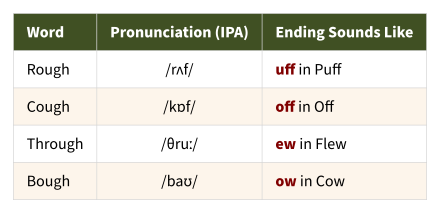
This is a typical challenge the newcomer faces when attempting to speak English. Error or no error, do not be shy to speak English, or you might never speak it confidently. Plough on manfully, no matter if others mock you. There is no single standard English any more; so there is no shame in mispronouncing. Once you hear the “correct” pronunciation, though, remember to use it thenceforth.
Names of places and people
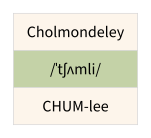
My second example is a light-hearted one. The word “Cholmondeley” has two meanings:
It is the place name of the “civil parish of Cholmondeley, Cheshire, England.” [2]. It is best known for the 19th-century Cholmondeley Castle and its 70 acres of landscaped gardens.
It is also the official family title of the Marquess of Cholmondeley.
I first came across this delightful nugget of a word in the writings of Gerald Durrell, a born naturalist and a charming writer. Because I was reading it silently, I mentally blundered through Cholmondeley, noting its strangeness, but not caring to sound it in my head. It was only when I had to pronounce the word audibly that I wondered how to do it. It sounded like the Tamil word “சோலமண்டலம்” or “Cōlamaṇṭalam” and believe me, this word is neither related to Cholmondeley nor sounds like it!
Take a look at Figure 2 for help in pronouncing it correctly. The first row shows the word, the second row, its IPA pronunciation, and the third, the plain English rendition, with capitalization denoting stress accent.
The spelling of British names is quaintly idiosyncratic to say the least. Take the monosyllabic “Hugh”, which is pronounced as /hjuː/ and like the English word “HUE”.
That was easy enough though. If you want a tough nut to crack, try guessing the pronunciation of “Featherstonehaugh”.3 Look it up on the web yourself before peeking into the footnote. 😉 .
And, on that quirky note, I will conclude this first of a series of blogs on “Mastering English”.
Feedback
Please email me your comments and corrections.
A PDF version of this article is available for download here:
References
Unless you are easily offended by stereotyping, in which case, avoid it.↩︎
The chapter on “Poetry” in my book Secrets of Academic Success has some poems that may be read aloud to great advantage.↩︎
There are many accepted variants in pronunciation. The one I like the most is: IPA: /ˈfænʃɔː/; Plain English: FAN-shaw.↩︎