Two Rupees
2010-12-01 | 2025-11-21
Estimated Reading Time: 9 minutes
This hitherto unpublished blog was written shortly after my arrival in India in 2010. It has been revised and recast suitably to be included here. I have named it simply “Two Rupees”, which in Hindi is “दो रुपये”, and in Tamil is “இரண்டு ரூபாய்”.1
It was drizzling. The slow influx of water had turned the earth to squishy mud. Puddles were everywhere. The water flowed along newly scoured gullies fashioned from the earth by the relentless pitter patter of raindrops. It was the fag end of the second monsoon but no one in India carps about the rain. “The more the better” is the common refrain in a land that lives or perishes by the monsoon.
I was driving through the grey haze conjured up by soft rain and bleak sky when my gaze chanced upon a human form crouched in the mud by the road. I looked into my rear-view mirror and discovered that it was a hapless man struggling to rise and stumbling and falling, only to rise and fall again, perhaps defeated by the slushy mud, or by fatigue, or by cold. Thrice I saw him struggle to stand and thrice fall, drenched in the rain. The pantomime being enacted had all the makings of a Chaplinesque comedy on screen, except that this was not reel life but real life: so comedy turned to tragedy.
By now, I had driven well past him and had the choice to drive on or to go back. Should I leave him to his dank and dingy destiny or should I turn back and lend a helping hand? The twinge of conscience to help won, drowning out the “look the other way” mentality. I turned and headed back to the struggling man.
As I walked out of my car—umbrella in hand—toward the man, I saw him stumble once more in the rain, and as he fell, he knocked his forehead on some stones in the mud, and blood oozed out, reddening his whole forehead. I hastened to him and offered an outstretched hand that he eagerly clasped while he tottered onto his feet, while trying to slip his left foot into a sandal that had come off. I helped him pull over his forehead a toque that had slipped so that the headgear applied some pressure to his bleeding forehead and helped stanch the flow of blood.
The whiff of alcohol came unbidden to my nostrils in the damp air. Effortlessly, I could tell that he was drunk. Age was not on his side either. I put him at seventy five or past it. Perhaps it was the strangeness of being helped by a stranger, or perhaps it was a sense of shame at being drunk and helpless, but he made a supreme effort and shod his left foot.
My gaze although fixated on the old man also registered the fact that he had dropped two one-rupee coins glistening in the mud during his attempt to get up, along with a small yellow cloth tied up in a bundle. Looking around, I saw a bench nearby, protected from the rain and harbouring three men. Thinking it would shelter him while he sobered up and recovered from his wound, I guided the old man toward it.
One of the men on the bench made a deprecating gesture to wave us off. He looked at me as if I had dragged a dead rat and encroached into his compound.
“Can’t you see that this is a workplace? We do work here. You can’t leave that derelict to lie on the bench. Then the whole world would crowd in,” he told me in Tamil. Only then did I realize that I had unwittingly wandered into the compound of a “factory” making hollow cement bricks.
“If you want to help him, why don’t you take him in your car and drop him at his home. I am sure that he does not live far from here,” the factory worker continued, half tauntingly. I had the dismaying feeling that the old man had been seen before in these environs, and had earned the contempt of the factory worker and his mates, from his repeated bouts of drunken loitering.
The suggestion to take the old man to his home in my car suddenly brought me down to earth. It was all very well to play the Good Samaritan, but not at the expense of soiling the fabric upholstery in my almost new car, which had barely clocked 3,500 km on the odometer. The old man was wet, muddy, and bloody, and I could not be sure that he would not retch in the car, drunk as he was.
The humanity in my heart was not boundless but calibrated in my head. I was prepared to help out but not at the expense of ruining the interior of my car. Just how hard is it for the world of ideals, of the scriptures, of all moral exhortations, to find full expression in the wet, muddy, bloody, untidy world of real life?
Quickly dismissing the thought of taking the old man home in my car, I decided that we would walk along the road until something happened. Meanwhile, the old man kept repeating that he had to reach Vadavalli bus stop, about two kilometres away, to get home, although he was obviously in no state to reach the bus stop, let alone travel alone by bus. We must have made a strange pair: the old man doddering along and me, umbrella in hand, walking slowly and ensuring that neither of us slipped or got more wet.
I tried hailing an auto as we walked, but none that passed by were empty. The light rain had driven folk who ordinarily would have been pedestrians to now become auto passengers. We continued until we reached a large tree with an umbrage of at least ten metres radius. The ground at the base of the tree was thankfully not very wet and certainly not muddy or slippery. I reasoned vaguely that the old man could sit on the ground and recline against the tree trunk and slowly recover enough to proceed home at his own pace.
I was still clueless about what exactly I should do next when a coconut seller suddenly came into view. He peddled tender coconut water at the other side of the tree, amidst a huge pile of green tender coconuts. He lent an empathetic ear to my remonstration that we cannot and should not let a fellow human being lie forlorn, wet, and struggling, helpless in the rain. It was very encouraging to exchange a few words with the coconut seller whose welcome sympathy for the old man—after the crassness of the factory worker—restored my faith in human kindness.
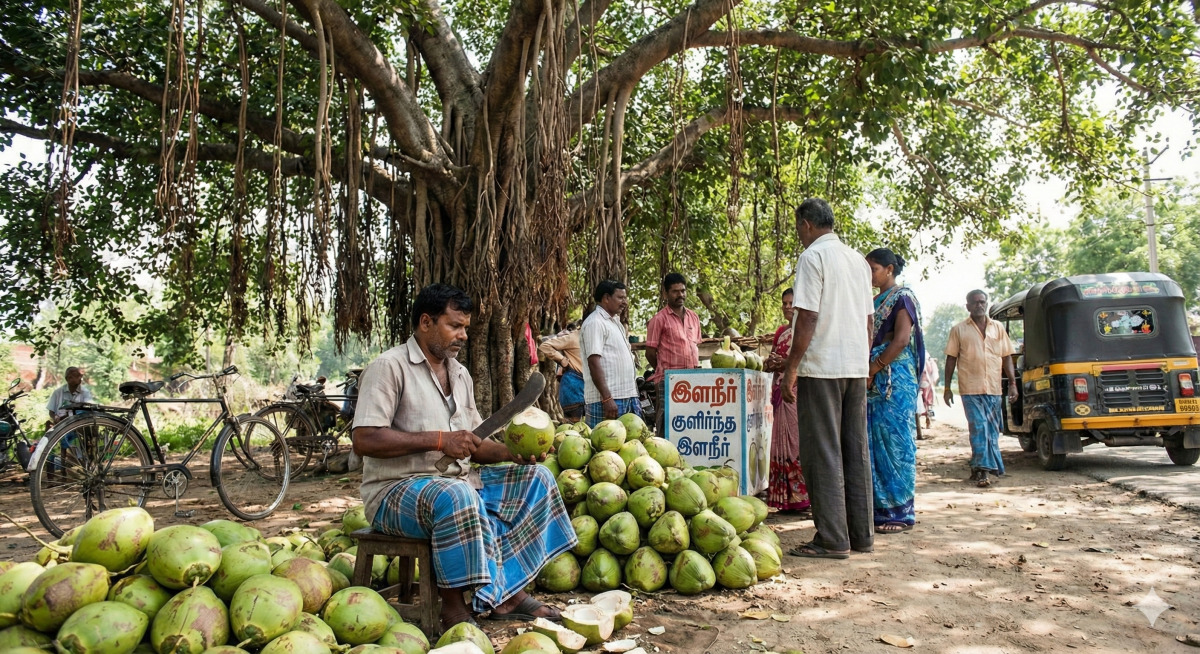
I had not given up hailing all passing autos, although half expecting them to scoot by rather than stop, when I suddenly struck lucky and one auto did stop. I spoke to the driver—a cheery and able young man—and explained the predicament that was the old man’s and now, to some extent, also mine.
He listened carefully and asked the old man where he lived. The latter answered “Annapuram”. The auto driver stated that the fare would be ₹50.00. At that point, the old man manfully retorted that he had the money to pay the auto driver. I recalled the two lost one-rupee coins and motioned politely to him that I would be happy to pay the fare.
The auto driver wanted to be doubly sure about where has was headed and so asked the old man, “Where in Annapuram?”
“Autonagar,” came the quick reply.
By now, the coconut seller had joined in the conversation and offered the helpful information that Autonagar was about one kilometre inside Annapuram. The auto driver accordingly raised his quote to ₹70.00. After being reassured that the old man would be taken right to his home and delivered into the care of his relatives, I paid the auto driver and sent the old man off. I cannot be sure if it was merely the rain, but I thought I saw two tears flowing down the sodden cheeks of the old man as he disappeared from view.
Wending my way back to my car and turning on the hot air—safe, warm, dry and cocooned by the comforts of technology—I was immensely grateful for life’s many blessings. Though we had both shared the same spacetime co-ordinates for a short while, I realized that the old man and I lived in very different worlds.
As I drove off, my gaze fell once again on the two one-rupee coins dropped by the old man, gleaming in the rain. What would become of the old man, whom chance and humanity had thrust into my company for half an hour? Would he have reached home to enjoy the warmth of hearth and kin? Was he being cared for? Or was home some dreamy, vaporous idea wafted up by his inebriated brain to fill a void in the real world? I shall never know. But every time I look upon two one-rupee coins, I shall recall this strange and wet encounter and the lessons it taught me about myself, humanity, and the world.
Acknowledgements
The image was generated by Google Gemini Nano-Banana AI in
accordance with my textual description. It was downloaded as
Gemini_Generated_Image_hysnznhysnznhysn.png. Kudos to
Google for a robust, usable, and free product.
Feedback
Please email me your comments and corrections.
A PDF version of this article is available for download here:
The rupee ₹ is the unit of currency in India. At the time of writing, one rupee coins were commonly used. Nowadays, with the prevalence of digital transactions, fewer and fewer people carry cash, let alone in small denominations.↩︎