Food as Medicine: Purple and Orange Sweet Potatoes
2025-12-17 | 2026-03-28
Estimated Reading Time: 13 minutes
Disclaimer
This blog is the first in a planned series on food as a path to health. Wherever possible, I have given expert references to back up what I have stated. Nevertheless, I must start with a disclaimer.
I am not a medical practitioner. The suggestions proffered through this blog are not a substitute for competent professional medical advice. Their sole purpose is to share what I have learned, so that others might be inspired to commence their own, personally crafted journeys to health and wellness through food, after seeking proper professional guidance.
We live in an age of food allergies. Even if you feel inclined to try the path I have trod, you must clear, with your own personal physician, the unfamiliar foods you are here inspired to consume. I do not assume any liability for problems that may arise if you ignore this warning. Caveat lector!
आहारः औषधवत्, औषधम् आहारवत्।
āhāraḥ auṣadhavat, auṣadham āhāravat.
Food (should be) like medicine; medicine (should be) like food.
Ayurvedic style aphorism
உணவே மருந்து; மருந்தே உணவு.
Uṇavē marundu; marundē uṇavu.
Food itself is medicine; medicine itself is food.
Siddha style aphorism
ἐν τροφῇ φάρμακον ἄριστον, ἐν τροφῇ φάρμακον κακόν.
en trophē pharmakon ariston, en trophē pharmakon kakon.
In food is the best medicine; in food is also the worst medicine.
Hippocrates
How my quest began
It all started in late 2019, just before the COVID-19 pandemic, while I was in hospital as the attendant1 to my wife, who was scheduled for surgery.
To while away the boredom, I tuned in to a BBC documentary channel on the TV in the hospital room. The featured programme happened to be on the longevity of the people of Okinawa, Japan.2 The documentary was utterly engrossing. Its primary thesis was that the purple sweet potato—a foundational part of the Okinawan diet—was a major contributor to the well-being and longevity of Okinawans.
I cannot now find a link to that BBC documentary. But there is a short clip entitled “Can this purple vegetable be the secret to a long life?” [1] that summarizes the facts on “why the people from the island of Okinawa off Japan, live longer than anywhere else in the world and far fewer elderly suffer dementia.” [1].
While not all of us might desire to live to a hundred years or beyond, I think everyone would desire to live their lives without physical or mental deficits, until the end. And that was how my quest began for physical and mental health and wellness through superfoods [2, 3].
Digging deeper
The sweet potato, Ipomoea batatas (L.) Lam., is a humble and shy vegetable—a root tuber that hides itself by growing underground. After watching the documentary on Okinawa, I decided to dig deeper (pun intended) into sweet potatoes.
I was surprised to discover that the primary research literature, on sweet potatoes and their benefits, was considerable and growing. I also found out that sweet potatoes exist in many different flesh-colours and that cultivars having different colours had been researched individually for their distinctive properties and specific benefits.
Why should we eat sweet potatoes?
Sweet potatoes confer manifold dietary benefits. To understand the what and the how of these benefits, we need to make a slight detour into the scientific basis behind this, albeit in simplified fashion. Sweet potatoes come in several phenotypes, and we will be looking at the white, purple, and orange types here.
Free Radicals and Antioxidants
Free radicals may arise in the body as a result of natural processes, or from external causes like the environment. They are unstable, electron-hungry molecular marauders that roam the human body, damaging cellular DNA, and causing chronic inflammation, in their virulent quest for that elusive electron.
Generally, when a free radical wrests an electron from another molecule, the electron donor would itself turn into one or more free radicals. Such a cascade can trigger a chain reaction of unstable molecules, leading to oxidative stress in the body, thereby accelerating ageing and contributing to chronic inflammatory conditions like diabetes, heart disease, cancer, dementia, and the like [4–6].
Antioxidants are a class of molecules that can assuage the free radicals’ hunger for electrons by donating electrons to them. They may be endogenous compounds like enzymes produced internally by the body, or exogenous substances, like vitamins, consumed from the outside.
Their claim to fame is that, after they neutralize free radicals, antioxidants retain their own stability, thereby arresting the cascade of free radical production, and stalling cellular damage from oxidative stress. Antioxidants are sometimes unflatteringly described as “free radical scavengers”.
Think of free radicals like gangs of rampaging thieves and antioxidants like the police, maintaining law and order. When the opposing forces are balanced, harmony reigns. Otherwise bodily mayhem can and does ensue.
Back to sweet potatoes
In this battle of good versus evil, where do sweet potatoes feature? They supply the “good guys” or antioxidants to neutralize the free radicals, thereby promoting bodily harmony, subduing inflammation, and preventing disease.
The Venn diagram shown in Figure 1 traces the chemical genealogy of the antioxidants in purple and orange sweet potatoes. It helps us understand why their benefits are not identical, and also why sweet potatoes in general—and these two varieties in particular—promote health and well being, so directly.
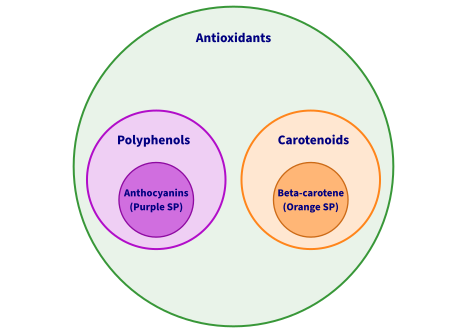
The term antioxidant is a functional classification. Substances belonging to disparate, large families of chemicals exhibit antioxidant properties. Indeed, antioxidants can range from enzymes and vitamins, through preservatives, to pigments.
With sweet potatoes, we are focused on two, pigment-based antioxidants:
anthocyanins for the purple variety, and
beta-carotene, also written as β-carotene, for the orange variety.3
The chemical families giving rise to these two distinct colours—the polyphenols and the carotenoids—are structurally different, and do not overlap, as shown in Figure 1.4
Succinctly put, the colour of the sweet potato determines the type of health benefit it confers [7].5
Benefits of eating sweet potatoes
The benefits of eating sweet potatoes, especially the purple variety, have been amply extolled on many YouTube videos and their associated blogs [8–14]. The specialist literature is also copious; we cite only a few representative articles here. [15–21].
Lower glycemic Index
Although its name has the adjective sweet in it, the Glycemic Index (GI) of sweet potatoes is lower than that of the normal potato, when cooked the same way. A lower glycemic index means blood sugar rises more slowly after eating, which is important for diabetics and weight watchers.
The method of cooking affects the value of the GI.6 Generally, boiling gives a lower GI than baking or roasting [22]. Moreover, the glycemic load, which takes into account the quantity consumed, is more relevant than the GI alone, for the prevention of diabetes.
Boiled sweet potatoes have a GI of 44–46 (low), whereas boiled ordinary potatoes have a GI of 56–101 (medium to high) [23]. The single vital takeaway is that sweet potatoes—regardless of their colour—have lower GIs than normal potatoes, and are therefore more friendly to diabetics [23, 24].
Resistant starch and fibre
Resistant starch is starch that resists digestion in the small intestine of healthy individuals. This is the mechanism by which sweet potatoes exhibit a lower glycemic index than ordinary potatoes, despite both being carbohydrate-rich. Sweet potatoes also contain both soluble and insoluble fibre. The resistant starch and fibre in sweet potatoes also feed gut-friendly bacteria and promote gut health [25–28].
Anthocyanins relieve oxidative stress
The anthocyanins in purple sweet potatoes act as antioxidants and boost overall health by neutralizing free radicals and preventing oxidative stress. It helps in preventing degenerative conditions like diabetes, heart disease, cancer, dementia, etc. [17–19; 29–31]. Boiling is preferable to baking or roasting purple sweet potatoes because high dry heat degrades anthocyanins more than moist heat.
Beta-carotene promotes good eyesight
The orange pigment in orange sweet potatoes, beta-carotene, is a precursor from which the body makes the fat-soluble Vitamin A, which promotes night vision, eye moisture, and overall immune function. In order to obtain the maximum benefit, orange sweet potatoes should preferably be cooked in fat or oil. [14]
Summary of benefits from eating sweet potatoes
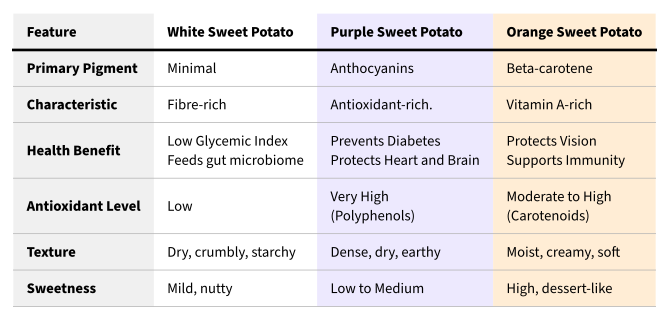
The major dietary characteristics of white, purple, and orange sweet potatoes are summarized and tabulated below in Figure 2:
Purple sweet potatoes and islands?
An interesting fact emerged while I was researching material for this blog. Purple sweet potatoes have been cultivated on islands like Okinawa, Hawaii, Bali, Sri Lanka, Taiwan, and possibly elsewhere [32]. Why is this so?
One intriguing hypothesis—based in part, on my own speculation, and in part on history—is this. Islands are particularly prone to storms which could conceivably destroy crops like rice, as happened in Okinawa [33, 34]. The islanders would have been prompted to find substitutes for rice, like the Okinawans did, and empirically settled on the purple cultivar as being more healthful.
The Coimbatore context
The sweet potato is called carkkaraivaḷḷik kiḻaṅku (சர்க்கரைவள்ளிக் கிழங்கு) in Tamil. The variety available at produce markets in Coimbatore, Tamil Nadu, where I live, has a pink skin and off-white flesh. It is the only variety sold at local outlets. It is different from the Okinawa purple sweet potato, which has a ruddy purple skin and uniform purple flesh. It is also visibly different from the orange sweet potato.
Both purple and orange sweet potatoes are beneficial and complementary in their health benefits. Either is far superior to the pink-skinned white-fleshed variety currently on sale.
The sweet potato may be boiled and eaten as is, steamed and mashed, or incorporated into a stew (kūṭṭu/கூட்டு) or curry (kari/கறி).
Interestingly, both the purple and orange sweet potatoes have traditionally been available at produce markets in South East Asian countries like Malaysia, Singapore, Indonesia, etc.
Given their demonstrated benefits—already documented some years ago in the Indian literature [20, 21, 35, 36]—why are there no purple or orange sweet potatoes on sale in the markets in Coimbatore?
The Odisha link
I found out that both the purple and orange sweet potato varieties have been acclimatized to Indian conditions and developed as distinct cultivars at the Central Tuber Crops Research Institute in Bhubaneshwar, Odisha [37]. The purple cultivar has been christened “Bhu Krishna”, and the orange cultivar, “Bhu Sona” [37, 38]. The interested reader is urged to read article one and article two online. The upshot is that these health-infusing cultivars are indeed available in India.
My own experience
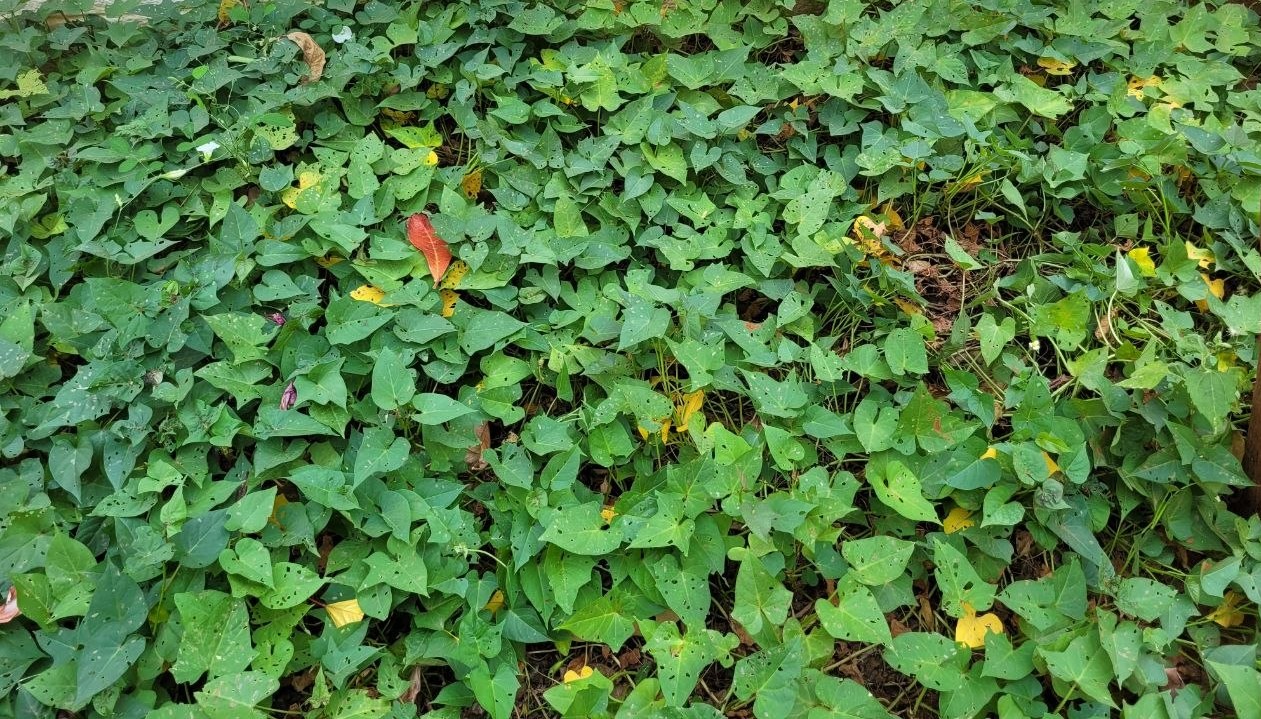
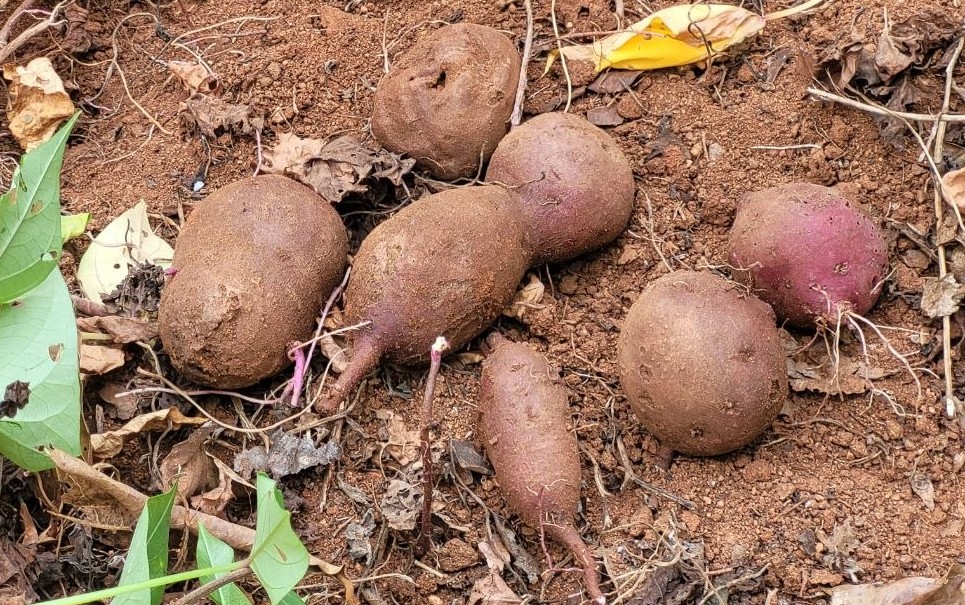
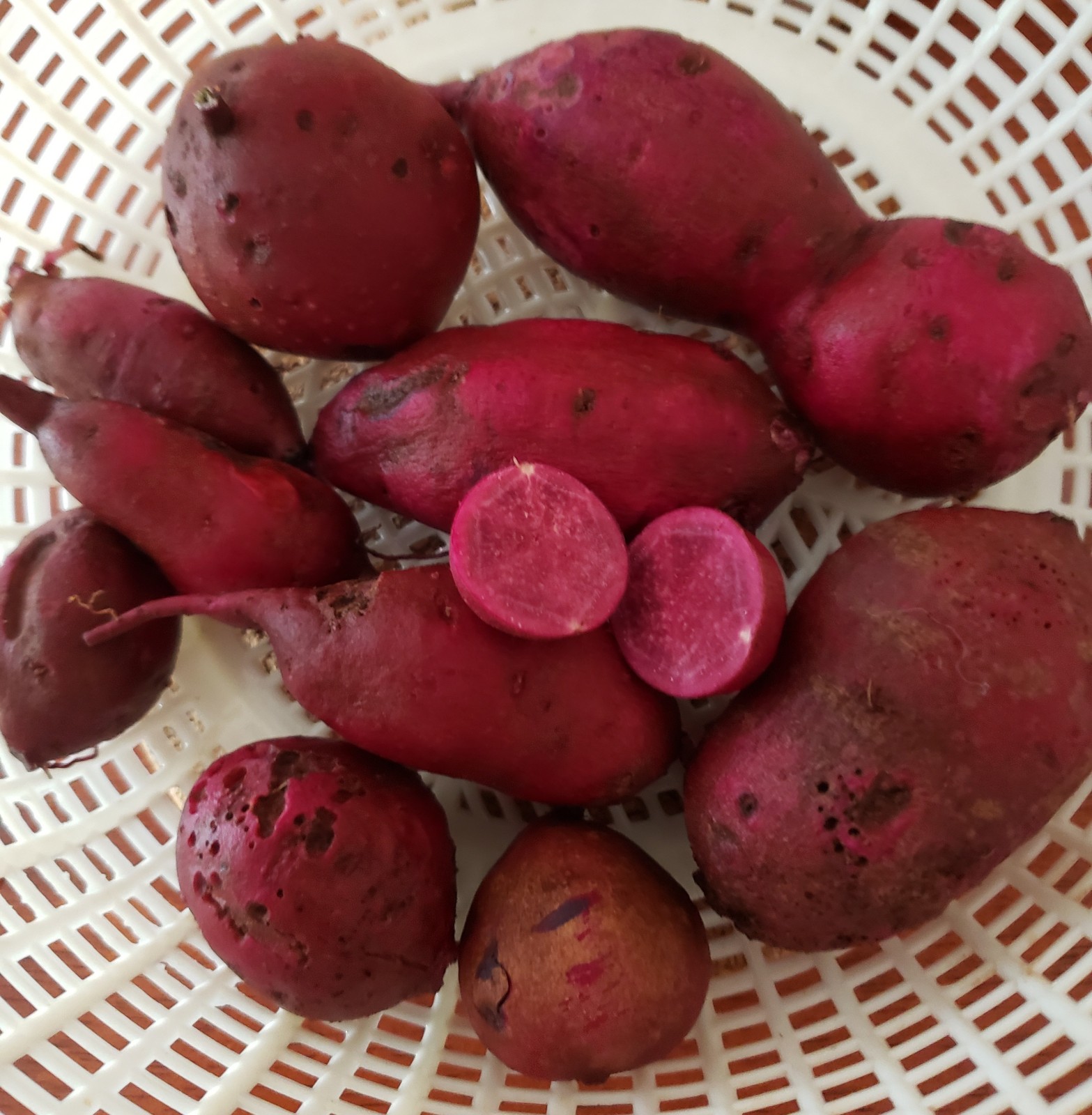
A friend of mine helped me to get slips of both varieties, and I tried growing them in my home garden. The first harvest was underwhelming. But the second time around, after I ensured proper soil preparation, timing, and harvesting, the results were modest but encouraging. Some images of the purple sweet potato bed and the dug-out tubers from my garden are shown below, in Figures 3-5, demonstrating that this vegetable can be planted and harvested successfully in and around Coimbatore.
Dissemination to farmers
Certified slips for the Bhu Krishna (purple) and Bhu Sona (orange) sweet potatoes may be obtained from:
CONTACT DETAILS HERE
Farmers with suitable tracts of land, a compatible soil type, and availability of sufficient water and labour should therefore be encouraged to plant purple and orange sweet potatoes, instead of, or in addition to, the currently cultivated variety.
It is noteworthy that sweet potato is relatively drought-tolerant [35] and a short-duration crop, with a plant-to-harvest cycle of three to four months. It will therefore be attractive to small farmers. It is also likely that the purple and orange cultivars will fetch a premium price, given their novelty and health benefits [36].
And that is the burden of this blog: to disseminate the benefits of purple and orange sweet potatoes, so that farmers feel sufficiently motivated to cultivate and sell them at local produce markets.
If, in turn, the buying public are inspired to try out these sweet potatoes, we would be on the cusp of a revolution to improve overall public health through wellness-promoting food.
Kindly disseminate this message among your farmer friends.
Key Takeaways
Boil purple sweet potatoes and eat them to prevent diseases like diabetes, heart disease, cancer, dementia, etc.
Cook orange sweet potatoes in fat or oil and eat them to promote eye health and immunity.
Eat sweet potatoes instead of potatoes for a lower glycemic load [23, 24].7
Sweet potatoes with resistant starch and fibre provide gut microbiome support [16].
Purple sweet potatoes may protect brain function and reduce dementia risk [9].8
The anti-inflammatory properties of anthocyanins in purple sweet potatoes may reduce heart disease risk [17, 30].
Anthocyanins in purple sweet potatoes may have anti-cancer properties [37].
Acknowledgements
I am deeply grateful to my dear friend, Professor M Muthuraman, retired Professor of Entomology, Tamil Nadu Agricultural University, for helping me to procure slips of the “Bhu Krishna” and “Bhu Sona” cultivars of the sweet potatoes for planting.
Feedback
Please email me your comments and corrections.
A PDF version of this article is available for download here:
References
In India, it is a pre-requisite for a relative or friend of an admitted patient to be in the same room as the patient, full time, keeping watch over them and their welfare. Such a person is called an attendant. This is not the practice in countries like Singapore, Malaysia, the United States, the UK, Canada, or Australia. But in India, a patient has to have a named and present attendant before he or she is admitted.↩︎
Okinawa is part of the Blue Zones where people live longer and happier than elsewhere on Earth.↩︎
Structurally, the overall molecular configuration is, in a manner of speaking, circular for the anthocyanins and linear for the beta-carotene.↩︎
Colour in this context refers to flesh colour; not skin colour. I have used the term white to refer to the nearly white colour of the most common variety of sweet potatoes.↩︎
The maxim “Eat a rainbow in every meal” should now be self-explanatory.↩︎
This is a perfect illustration of the maxim of Hippocrates, in the epigraph quoted at the beginning of this blog: even the method of cooking can affect whether a food is beneficial or deleterious to health.↩︎
Vital, given India’s diabetes epidemic.↩︎
The Okinawa evidence.↩︎