e Unleashed
2004-03-01 | 2025-07-21
Estimated Reading Time: 25 minutes
“Lisez Euler, lisez Euler, c’est notre maître à tous.”
“Read Euler, read Euler. He is the master of us all.”
Pierre-Simon Laplace
“Das Studium der Werke Eulers wird immer die beste Schule für die
verschiedenen Gebiete der Mathematik bleiben, und nichts anderes kann
sie ersetzen.”
“The study of Euler’s works will remain the best school for the
different fields of mathematics, and nothing else can replace it.”
Carl Friedrich Gauss
Prologue
This blog follows on from the previous blog The Exponential and Logarithmic Functions. We begin with a brief review of the life of Euler both as a human being and as a mathematician. We look at the complex exponentials, the hyperbolic functions, the catenary, and the linear and logarithmic spirals. We conclude with the recognition that the complex exponentials may be viewed as vectors undergoing linear transformations when they are differentiated or integrated. There is a third blog A Tetrad of Captivating Problems. It is meant to be read in conjunction with these two blogs on e.
Leonhard Euler
The history of \(e\) is a record of “almost there but not quite” with about a century elapsing from the time when it was almost discovered to the time it was assigned its rightful place in mathematics by Euler (whose name, by the way, is pronounced “Oiler”, not “You-ler”).
Hence, no discussion of \(e\) will be complete without at least a thumbnail sketch of Leonhard Euler (1707–1783) the Swiss polymath who “bestrode eighteenth century mathematics like a colossus”. Before taking up the thread of \(e\) in mathematics, I would like to briefly discuss Euler the man, and Euler the mathematician, for us to better appreciate his ginormous contributions to human knowledge.
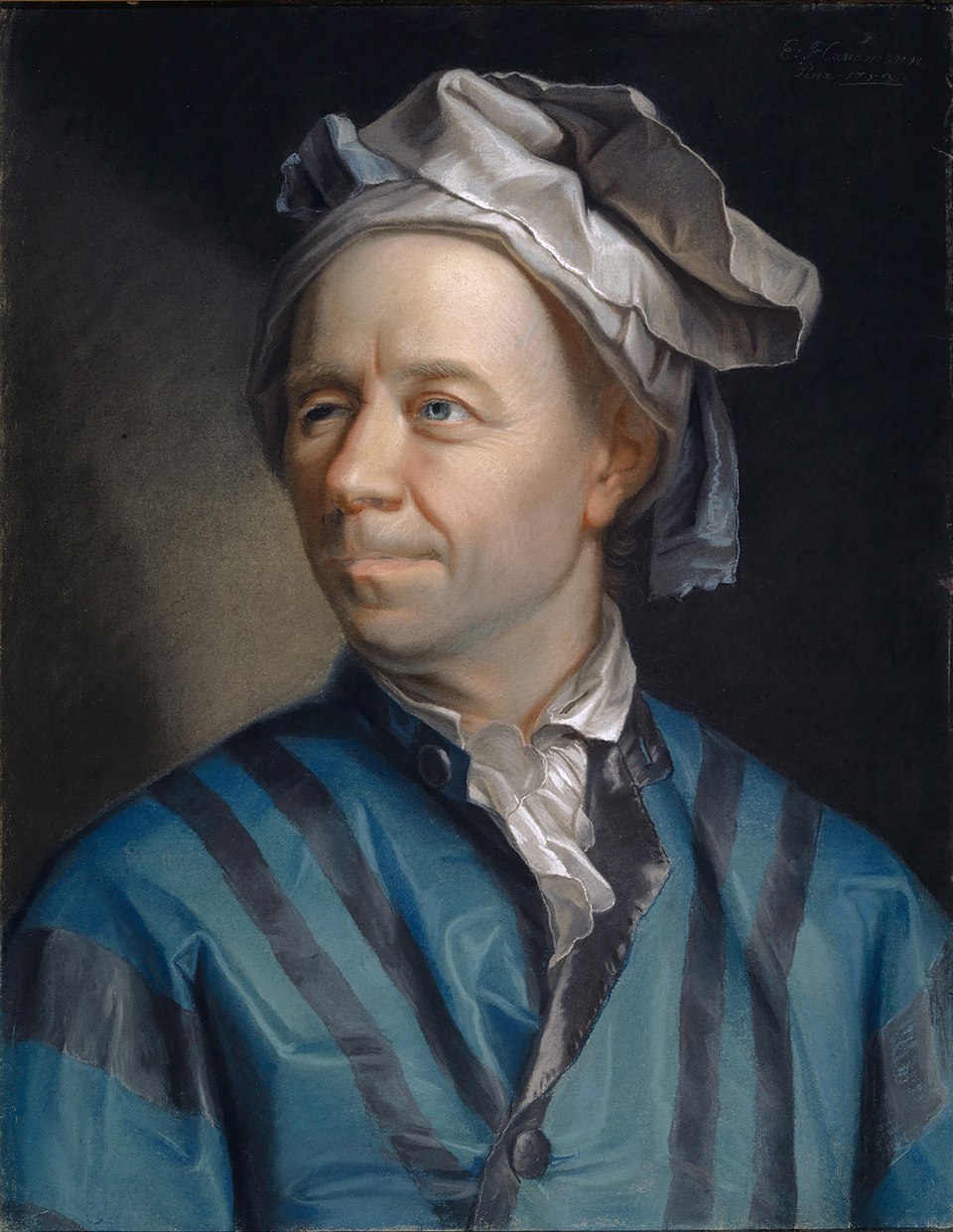

Euler the man
Euler emerges as a man blessed with many positive attributes of character that helped him maintain an even keel in his life and work, although he lived in politically turbulent times, and had to translocate several times.
He was a child of the sun, as astrologers would say, with an open and cheerful mind, uncomplicated, humorous and sociable. Even though wealthy to rich in the second half of his life, he was modest in material affairs, always free of any conceit, never vindictive, but self-assured, critical, and daring. [1]
Certain attributes of mind and temperament have been identified as contributing to Euler’s prodigious output:
He had “a possibly unique memory. … Anything Euler ever heard, saw, or wrote, seems to have been firmly imprinted forever in his mind.” [1].
“He was also a fabulous mental calculator, able to perform intricate arithmetical computations without benefit of pencil and paper.” [2].
Euler had “a rare ability of concentration. Noise and hustle in his immediate vicinity barely disturbed him in his mental work.” [1].
The ability to do “steady, quiet work” [1] also made Euler who he was.
In sum, Euler’s prodigious output was founded upon a generous and equable character coupled with a prodigious memory, an ability to withdraw from his surroundings, however distracting, to concentrate on what he wanted to, and the habit of steady, quiet work, day after day [1].
Adversity into opportunity
Euler lost the sight in his right eye during a fever when he was a young man, not quite thirty. But he never let this disability hinder him. Rather, he took it as one less distraction to enable him to concentrate all the more on his work. Euler never let blindness get in the way of his scholarly pursuits, his mathematical research, or the documentation of his work.
When later in life, at the age of sixty-four, he lost vision in his left eye as well, due to an unsuccessful cataract operation, he did not bemoan his fate, but kept pushing the frontiers of mathematics, and used his son and others as scribes to record his mathematical researches. In this, he was helped by his eidetic memory and phenomenal power of mental calculation.
On one occasion, when he was moving from one city to another with his family by ship, a storm sank the ship carrying his personal effects. A book manuscript that he had been working on was lost in the shipwreck. Unfazed, Euler, upon reaching his destination, dictated the entire manuscript from memory and thereby recovered the lost book.
Although it is not so recorded historically, I think that a fitting motto to describe his courage in the face of adversity is nil desperandum.
Euler the mathematician
Euler combined in himself the mathematician, scientist, engineer, and teacher. He was the preeminent mathematician of the eighteenth century, who pioneered entire fields of mathematics, systematized its nomenclature, and shared his research by publishing it. He was one of the founding fathers of mathematics as a recognized discipline, and contributed immensely to its breadth and scope.
Euler harnessed imagination, intuition, and discipline to facilitate mathematical discovery. He was unafraid to experiment with mathematics, and intrepid enough to explore uncharted mathematical territory to see where it led. If he found unexpected results or dazzling insights, he usually checked the veracity of his conclusions by deriving the same result using another method. In this way, he justified his bold, experimental approach to opening up undiscovered fields of mathematics. He unveiled new vistas, built bridges between the mathematical islands of his time, and left the field far more integrated and meaningful than when he started out.
In his search for deeper interconnections among the branches of mathematics, for example, those in the case of \(\zeta(2)\) would be among harmonic series, natural logarithms, and trigonometry. [3].
From his perspective, discoveries were prime; rigorous foundations could come later. Sometimes, his peers did not accept his results. Undeterred, he would provide a different, more acceptable proof some years later. My takeaway is that he had an inner monitor that gave him unshakeable certitude when he discovered a new result. Guided by that inner assurance, he bequeathed results that passed the test of time and scrutiny.
…Euler devoted intense efforts to incorporate complex numbers into the overall picture of mathematics as a powerful tool for advanced research, but much less so to the question of clarifying the proper foundations, geometric or other, of this system of numbers. Euler’s attitude is truly representative in this regard of the mathematical community and of its leading figures at the time. [4].
Publications
Euler wrote clearly and directly. It is no wonder that his Elements of Algebra, first published in 1765 is still available in English translation in a revised edition even today [5]. Euler wrote voluminously. The collected works of Euler, published under the title Opera Omnia, number 80 printed volumes, as at 2025, with another in preparation. Additional volumes of manuscripts and notes are planned, but will be released only digitally online.
According priority to Lagrange
There is a charming anecdote about Euler giving up precedence in research when he heard from a young, up-and-coming Italian-French mathematician, named Joseph-Louis Lagrange. Euler had been working on what we now know as the calculus of variations. When Lagrange wrote to Euler with some results in the same field, Euler was magnanimous in his response, and accorded the younger mathematician priority in publication, writing to him as follows:
Your analytical solution of the isoperimetric problem contains, as far as I see, everything one could want in this area and I am extremely happy that this theory, which after my first attempts I was hardly alone in studying, has been brought by you to the height of perfection. The importance of the question motivated me to the point where with the help of your illumination I deduced the analytic solution myself. However, I decided to conceal this until you publish your results, since in no way do I want to take away from you any of the glory that you deserve. [6, p 216]
Such magnanimity is extremely rare even in the circles of scientific history. Their joint contribution is today known as the Euler-Lagrange equation.
Letters to a German Princess
Mathematician par excellence that he was, Euler was once asked by a prince to write on science and philosophy in a manner that could be understood by a young princess. A lesser human being would have politely demurred feeling such a commission beneath his eminence and station. But not Euler. He patiently wrote over 200 letters to the German princess on a variety of subjects [7, 8]:
While in Berlin, Euler was asked to provide instruction in elementary science to the Princess of Anhalt Dessau. The result was a multi-volume masterpiece of exposition, subsequently published as “Letters of Euler on Different Subjects in Natural Philosophy Addressed to a German Princess”. This compilation of over 200 “letters” introduced subjects as diverse as light, sound, gravity, logic, language, magnetism, and astronomy. [2].
This incident exemplifies Euler’s broad interests, insatiable curiosity, trans-disciplinary expertise, innate humility, and profound seriousness in approaching whatever task he was assigned, without allowing the ego to intrude.
Mathematical Legacy
Euler contributed to number theory, infinite series, complex variables, algebra, geometry, combinatorics, probability, calculus of variations, differential equations, mechanics, hydrodynamics, astronomy, naval architecture, and many other fields. He did experiments on the firing of cannonballs, prepared maps, advised the Russian Navy, and even tested designs for fire engines [2].
In mathematical notation alone, Euler contributed the following:
Euler introduced much of the mathematical notation in use today, such as the notation \(f(x)\) to describe a function and the modern notation for the trigonometric functions. He was the first to use the letter \(e\) for the base of the natural logarithm, now also known as Euler’s number. The use of the Greek letter \(\pi\) to denote the ratio of a circle’s circumference to its diameter was also popularized by Euler (although it did not originate with him). He is also credited for inventing the notation \(i\) to denote \(\sqrt{-1}\). [9]
There is a dedicated Wikipedia page giving a list of topics named after Euler [10]. Many theorems and other results discovered by Euler were named after their second discoverer, simply to confer uniqueness and to avoid confusion with the superfluity of other results attributed to Euler.
We are now ready to resume our account of Euler’s famous number \(e\), following on from the previous blog: The Exponential and Logarithmic Functions.
The complex exponentials
As we have seen, Euler experimented mathematically to come up with new and insightful linkages that blazed new paths. Newton had discovered the infinite series \[e = 1 + \dfrac{1}{1!} + \dfrac{1}{2!} + \dfrac{1}{3!} + \dfrac{1}{4!} + \dots\qquad{(1)}\] from the binomial expansion for \(\left( 1 + \tfrac{1}{n} \right)^n\) by letting \(n \to \infty\).
Euler generalized this equation to \[\begin{aligned} e^x &= \lim_{n \to \infty}\left ( 1 + \dfrac{x}{n} \right) ^n\\ &= 1 + \dfrac{x}{1!} + \dfrac{x^2}{2!} + \dfrac{x^3}{3!} + \dfrac{x^4}{4!} + \dots \end{aligned}\qquad{(2)}\] which may indeed be used as another definition of the exponential function.
Euler now substituted \(ix\) for \(x\) in Equation 2 and segregated the real and imaginary terms to get \[\begin{aligned} e^{ix} &= 1 + \dfrac{ix}{1!} + \dfrac{(ix)^2}{2!} + \dfrac{(ix)^3}{3!} + \dfrac{(ix)^4}{4!} + \dots\\ &= \left( 1 - \dfrac{x^2}{2!} + \dfrac{x^4}{4!} \dots\right) + i\left(x - \dfrac{x^3}{3!} + \dfrac{x^5}{5!} + \dots \right) \end{aligned}\qquad{(3)}\]
By recognizing the series within the first pair of parentheses to be the power series for \(\cos x\), and the series within the second pair of parentheses to be the power series for \(\sin x\), Euler came up with the remarkable equation \[\exp{(ix)} = e^{ix} = \cos x + i \sin x\qquad{(4)}\] This particular equation unites the exponential and trigonometric families of functions under the banner of the complex exponentials and is called Euler’s formula. It is used to solve four interesting problems in the related blog A Tetrad of Captivating Problems.
By substituting \((-ix)\) for \((ix)\) above he got \[\exp{(-ix)} = e^{-ix} = \cos x - i \sin x\qquad{(5)}\] which led to \[\cos x = \dfrac{e^{ix} + e^{-ix}}{2}\qquad{(6)}\] and \[\sin x = \dfrac{e^{ix} - e^{-ix}}{2i}\qquad{(7)}\]
These are powerful equations uniting what might otherwise have been unrelated branches of mathematics. This unification was achieved by the disciplined imagination and willingness to experiment that Euler displayed: qualities that are worth emulating.
Another derivation
Recently, I came across a YouTube video with the intriguing title “Proof of Euler’s Formula Without Taylor Series” [11]. After watching it, I realized that it was all about prior assumptions. The one assumption made in the video is that the exponential function is its own derivative. Using this, one may derive the Euler formula by another route, as outlined below:
Let \(z = \cos\theta + i\sin\theta\).1
Differentiate both sides with respect to \(\theta\) \[\begin{aligned} \frac{\mathrm{d}z}{\mathrm{d}\theta} &= -sin\theta + i\cos\theta\; ; \text{ re-arrange terms}\\ &= i\cos\theta + (-1)\sin\theta\; ; \text{ substitute } i^2 = -1\\ &= i\cos\theta + (i^2)\sin\theta\\ &= i(\cos\theta + i\sin\theta)\\ &= iz \end{aligned}\]
We now have the differential equation \(\dfrac{\mathrm{d}z}{\mathrm{d}\theta} = iz\), which may be solved by separating variables: \[\begin{aligned} \frac{\mathrm{d}z}{z} &= i\mathrm{d}\theta\\ \int \frac{\mathrm{d}z}{z} &= \int i\mathrm{d}\theta\\ \ln z &= i\theta + C\; ; \text{ exponentiate both sides}\\ \exp(\ln{z}) &= \exp(i\theta + C)\\ z &= \exp(C)\exp(i\theta)\; ; \text{ let } \exp(C) = K\\ &= Ke^{i\theta} \end{aligned}\]
We now have \[z = Ke^{i\theta} = \cos\theta + i\sin\theta\qquad{(8)}\]
To evaluate \(K\), we set \(\theta = 0\): \[\begin{aligned} Ke^{i\theta} &= \cos\theta + i\sin\theta\; ; \text{ set }\theta = 0\\ Ke^{0} &= \cos(0) + i\sin(0)\\ K(1) &= 1 + 0\\ K &= 1\\ \end{aligned}\]
Substituting \(K = 1\) in Equation 8, we get \(e^{i\theta} = \cos\theta + i\sin\theta\), which is Euler’s formula.
This second derivation of Euler’s formula echoes the modus operandi of Euler, who used to get the same result by two different methods. The only logical trap one must guard against in such cases is circularity.
YouTube video worth watching
jHan has put out a polished explanation of Euler’s formula on YouTube, using two different approaches [12]. It is clearly explained, allowing little room for confusion or ambiguity, and is within the grasp of the average high-schooler. Highly recommended. Watch it more than once if need be.
Linear differential equations with constant coefficients
Exponentials, both real and complex, play a central role in the solution of linear differential equations with constant coefficients. That is a huge area of mathematics that deserves several blogs of its own, and we will not venture into it in detail here. The vital point to keep in mind, though, is the primary property of the exponential function: it is its own derivative. All magical powers derive from this one aspect of exponentials. Reviewing the blog Differential Equations will also help.
Exponential growth and decay
The equation \[\dfrac{dy}{dx} = \pm ky\; ; \; k \in \mathbb{R}; k > 0\] It models exponential growth with the positive sign, and exponential decay with the negative sign.
The solutions are of the form \(y = Ae^{\pm kx}\). This equation is so widely applicable that it would not be possible to give all instances of its occurrence both in natural and man-made settings. In its growth form, it can describe population growth, bacterial growth, continuous growth of investments etc. In its decay form, it governs radioactive decay, chemical reaction kinetics, voltage decays in RC (resistance-capacitance) circuits, etc.
Simple harmonic motion
The other equation is \[\dfrac{d^2y}{dx^2} = -k^2x\; ; \; k \in \mathbb{R}; k > 0\] which defines simple harmonic motion. Its solution is \(A \sin(kx) + B \cos(kx)\). Remembering that the sinusoids may be expressed as complex exponentials, this too is a solution in terms of exponentials. This equation underlies the study of many oscillatory systems in civil, mechanical and electrical engineering, and in physics. Note that in this and other cases, the validity of the solution may be verified by working backwards from the solution to the original differential equation.
Circular and hyperbolic functions
The trigonometric functions are also called circular functions. This is because the \(\cos\) and \(\sin\) functions of the angle, made by the radius and the positive \(x\)-axis, may be defined to be the projections, on the \(x\) and \(y\) axes respectively, of a point that moves along a circle of radius one unit, centred on the origin. This has already been discussed in two previous blogs:
The functions that arise from replacing \(ix\) by \(x\) in Equations 6,7 are the hyperbolic functions defined as: \[\cosh x = \dfrac{e^{x} + e^{-x}}{2}\qquad{(9)}\] and \[\sinh x = \dfrac{e^{x} - e^{-x}}{2}\qquad{(10)}\] which possess analogous properties to the circular functions. We will state just three of these here and leave the rest for personal exploration:
| Circular Functions | Hyperbolic Functions |
|---|---|
| \(\cos^2 x + \sin^2 x = 1\) | \(\cosh^2 x - \sinh^2 x = 1\) |
| \(\cos(-x) = \cos(x)\) | \(\cosh(-x) = \cosh(x)\) |
| \(\sin(-x) = -\sin(x)\) | \(\sinh(-x) = -\sinh(x)\) |
The hyperbolic functions are not mere mathematical curiosities, but have practical applications as well.
We will now take a look at two very interesting curves that arise from the exponential function: the catenary and the logarithmic (or equiangular) spiral.
The catenary
In 1690, Jakob Bernoulli, a member of the famous Swiss mathematical family, asked what would be the shape assumed by a loose string, or uniform chain, hanging under the influence of gravity, but supported at its two ends, as shown in Figure 2. One year later, three solutions were submitted: from Leibniz, Christian Huygens and Jakob’s brother Johann Bernoulli. They all gave the same solution, arrived at from different approaches.

The resulting curve was called a catenary, which comes from the Latin catena meaning chain. The equation of the catenary they derived was: \[y = \dfrac{a}{2}\left[e^{\frac{x}{a}} + e^{-\frac{x}{a}}\right] = a\cosh\left[\frac{x}{a}\right]\] where \(a\) is determined by the physical properties of the chain. The graphs of a family of catenaries are shown in Figure 3:
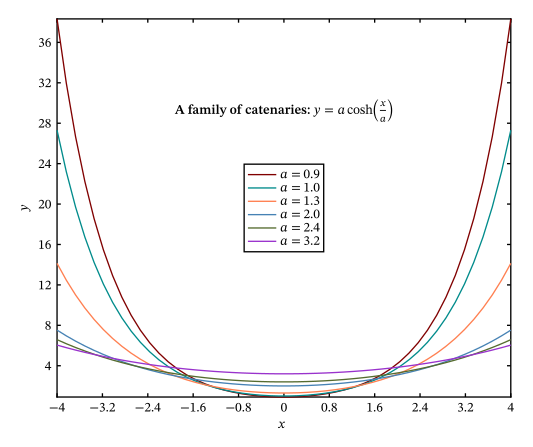
Note that the catenary is parametrized by only a single constant \(a\). Other curve families sharing this attribute include circles, squares, and parabolas, all of which are geometrically similar to each other in their respective families. Inductively, we deduce that all catenaries are similar to each other as well. Changing the single parameter \(a\) changes the scale, allowing any one catenary to become congruent to another different catenary.2 Catenaries, besides appearing in Nature, are used in video games, to render realistic depictions of suspended ropes and chains.
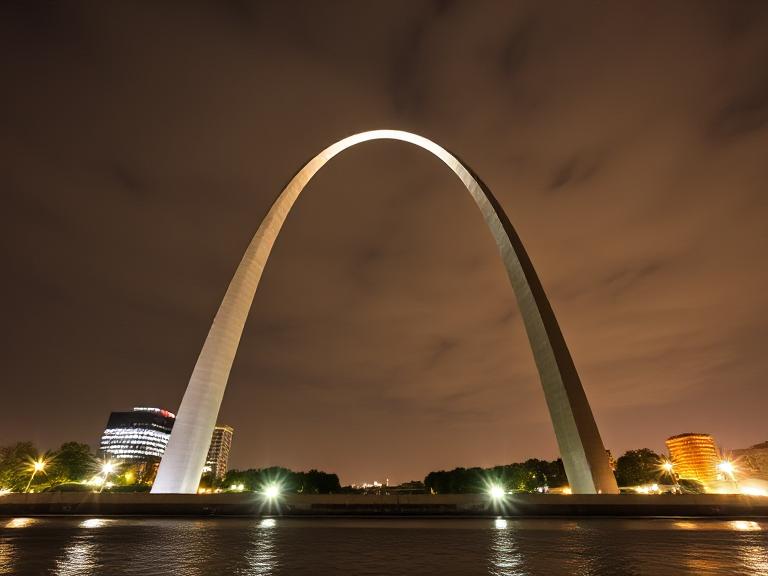
The Gateway Arch in St. Louis, MO, USA, approximately depicts an inverted catenary in a monument, and is illustrated in Figure 4.
The logarithmic spiral
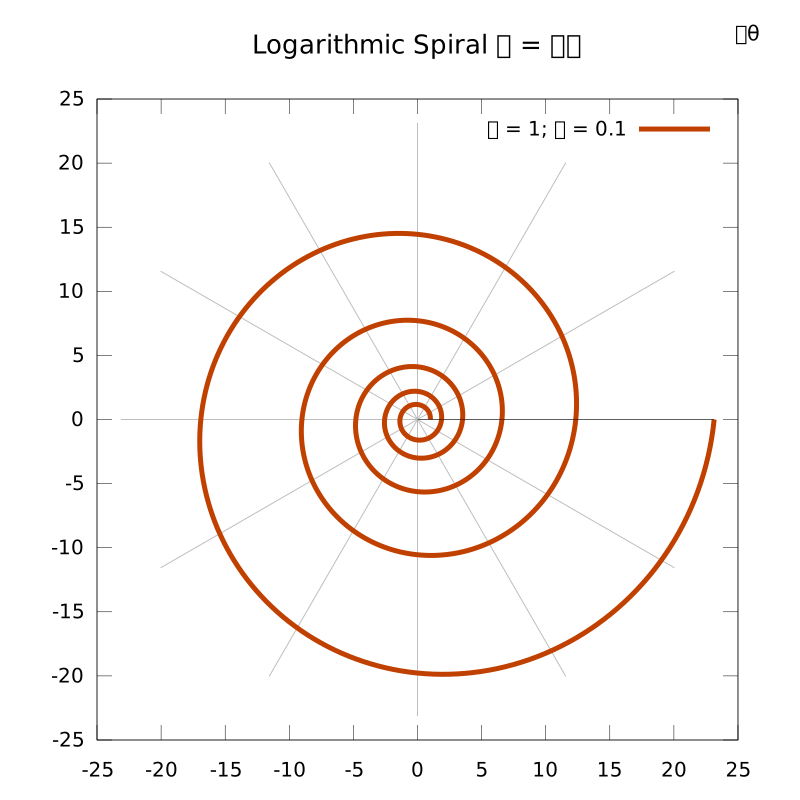
The logarithmic spiral looks like the mainspring of a mechanical clock or watch. It has been studied extensively by mathematicians and naturalists. It is defined by the polar equation \[r = ae^{k\theta}\; ; \; a, k \in \mathbb{R}; a > 0; k\neq 0\qquad{(11)}\]
This curve was studied in detail by the mathematician Jakob Bernoulli who gave it the name spira mirabilis or the marvellous spiral. He loved it so much that he wanted it engraved on his tombstone. Due to an error, though, the linear or Archimedean spiral was carved instead!3
Interactive demo
The logarithmic spiral is part and parcel of Nature. It is a pattern found in galaxies, hurricanes, the nautilus shell, sunflower seed patterns, and spider webs, among others. To better understand how the values \(a\), \(k\) and \(\theta\) affect its shape, try using this interactive demo in your web browser. Play around with the different sliders and see how they affect the nature shape of the curve.
I was bequeathed this program—unasked, mind you—by the Anthropic AI Claude Sonnet 4. As long as you have your wits about you, and can detect mistakes that you make and the AI makes, the partnership with AI can be a very productive one, sometimes bordering on almost human collaboration.
Equiangular spiral
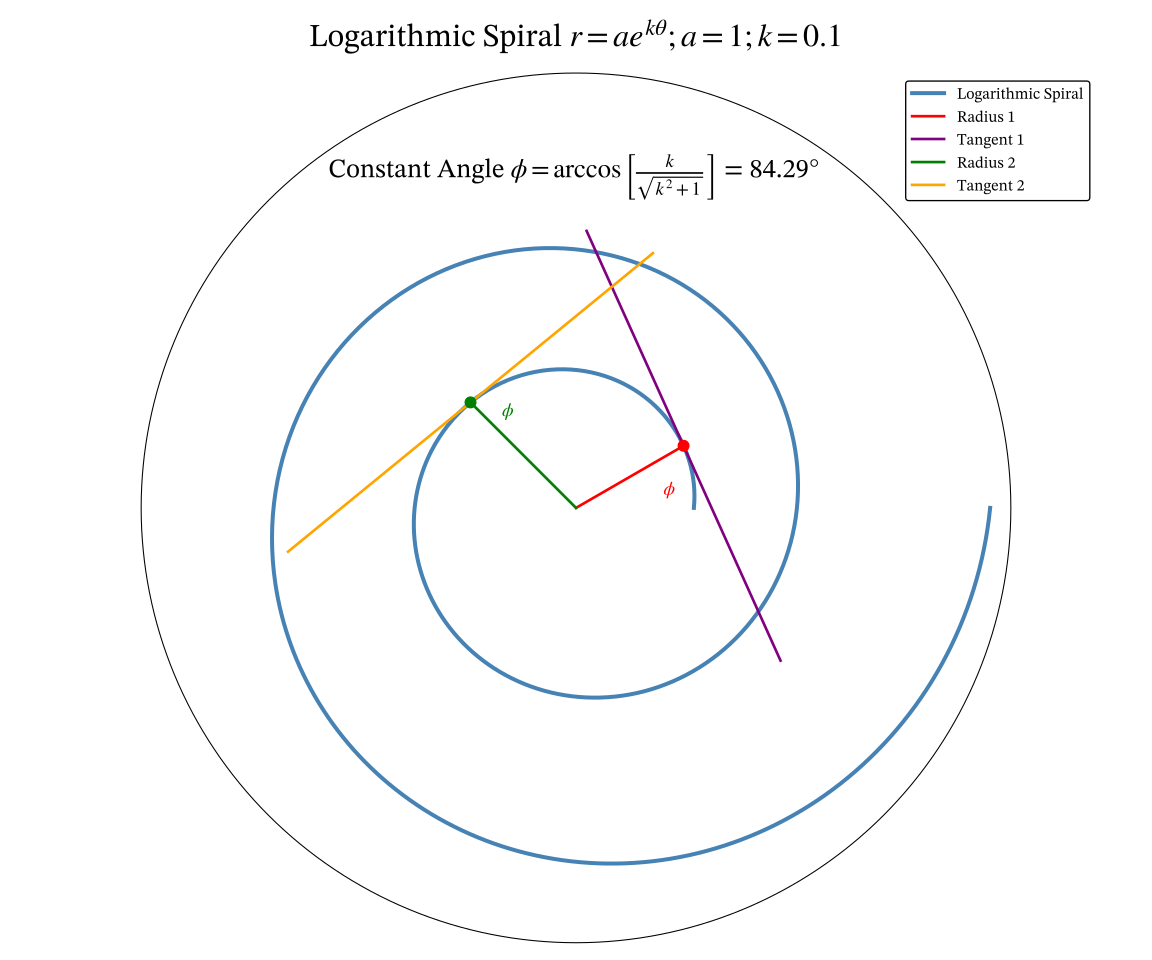
What does equiangular spiral mean when we refer to the logarithmic spiral? Every straight line through the pole intersects the spiral at the same angle. The angle between the radius and tangent vectors is constant, and independent of the value of the polar angle. This is why the logarithmic spiral is also called the equiangular spiral.
What happens when the value of \(k\) is varied in the interactive demo? When \(k\) is negative, the spiral coils inward; when \(k\) is positive, the spiral coils outward. The closer \(k\) is to zero, the tighter the coil. When \(k\) equals zero, we get a circle. And the circle is the quintessentially equiangular curve.
The angle between the radius and tangent of a circle is always \(\frac{\pi}{2}\) or \(90°\) irrespective of where the radius and tangent meet on the circle. But is the circle then a logarithmic spiral? In Equation 11, if we set \(k=0\), we get the polar equation \(r = a\) which is the equation of a circle of radius \(a\). So, the circle is a limiting case of an equiangular or logarithmic spiral, which closes upon itself.
Proving equiangularity
Let us now derive the angle between the radius and tangent for the logarithmic spiral. The parametrized Cartesian equations of a logarithmic spiral are: \[\begin{aligned} x &= r \cos \theta &= ae^{k\theta}\cos\theta\\ y &= r \sin \theta &= ae^{k\theta}\sin\theta \end{aligned}\qquad{(12)}\]
We will now compute \(\frac{\mathrm{d}y}{\mathrm{d}\theta}\) and \(\frac{\mathrm{d}x}{\mathrm{d}\theta}\) as steps toward computing \(\frac{\mathrm{d}y}{\mathrm{d}x}\), which will be required to draw tangents to the spiral. \[\begin{aligned} \frac{\mathrm{d}x}{\mathrm{d}\theta} &= (kae^{k\theta}\cos\theta - ae^{k\theta}\sin\theta)\\ &= r(k\cos\theta - \sin\theta)\\ \frac{\mathrm{d}y}{\mathrm{d}\theta} &= kae^{k\theta}\sin\theta + ae^{k\theta}\cos\theta\\ &= r(k\sin\theta + \cos\theta) \end{aligned}\qquad{(13)}\]
The easiest way to find the angle between the radius and tangent is using the dot product of vectors. Let the radius vector be called \(\mathbf{r}\) and the tangent vector be called \(\mathbf{t}\). Then, we may express them using their Cartesian components so: \[\mathbf{r} = (r\cos \theta, \sin \theta)\qquad{(14)}\] Likewise, from Equation 13, we know that \[\mathbf{t} = (r(k\cos\theta - \sin\theta), r(k\sin\theta + \cos\theta))\] If the angle between these two vectors is \(\phi\), we may say \[\begin{aligned} \mathbf{r}\cdot\mathbf{t} &= \lVert{\mathbf{r}}\rVert\lVert{\mathbf{t}}\rVert\cos\phi\\ \cos\phi &= \frac{\mathbf{r}\cdot\mathbf{t}}{\lVert{\mathbf{r}}\rVert\lVert{\mathbf{t}}\rVert}\\ \end{aligned}\qquad{(15)}\] Clearly, \[\lVert\mathbf{r}\rVert = \sqrt{r^2\cos^2 \theta + r^2\sin^2 \theta} = r.\qquad{(16)}\] Also, \[\begin{aligned} \lVert\mathbf{t}\rVert &= \sqrt{\left[r(k\cos\theta - \sin\theta)\right]^2 + \left[r(k\sin\theta + cos\theta)\right]^2}\\ &= r\sqrt{k^2\cos^2\theta -2k\cos\theta\sin\theta + \sin^2\theta +k^2\sin^2\theta + 2k\sin\theta\cos\theta + \cos^2\theta}\\ &= r\sqrt{(cos^2\theta + \sin^2\theta)[k^2 + 1]}\\ &= r\sqrt{k^2 + 1}. \end{aligned}\qquad{(17)}\]
From the definition of the dot product, we have \[\begin{aligned} \mathbf{r}\cdot\mathbf{t} &= \left[r\cos\theta(rk\cos\theta - \sin\theta)\right] + \left[r\sin\theta(rk\sin\theta + \cos\theta)\right]\\ &= r^2k\cos^2\theta -r\sin\theta + r^k\sin^2\theta + r\sin\theta\cos\theta\\ &= r^2k(\cos^2\theta + \sin^2\theta)\\ &= kr^2. \end{aligned}\qquad{(18)}\]
Substituting from Equation 16, Equation 17, and Equation 18 into Equation 15, we get: \[\begin{aligned} \cos\phi &= \frac{\mathbf{r}\cdot\mathbf{t}}{\lVert\mathbf{r}\rVert\lVert\mathbf{t}\rVert}\\ &= \frac{kr^2}{r(r\sqrt{k^2 + 1})}\\ \phi &= \cos^{-1}\left[\frac{k}{\sqrt{k^2 + 1}}\right]. \end{aligned}\qquad{(19)}\]
In Equation 19, \(\phi\) only depends on \(k\) and not on \(r\) or \(\theta\). Therefore the angle between the radius and tangent at any point on the curve is constant and independent of its position. As a check, when \(k = 0\), we have a circle where \(\cos\phi = 0\) signifying that the radius and tangent are perpendicular, as expected. The equiangular property of the logarithmic spiral is illustrated below in Figure 6:
Linear versus Logarithmic Spirals
The linear4 and logarithmic spirals offer a compelling visual demonstration of the difference between an arithmetic progression (AP) and a geometric progression (GP).5
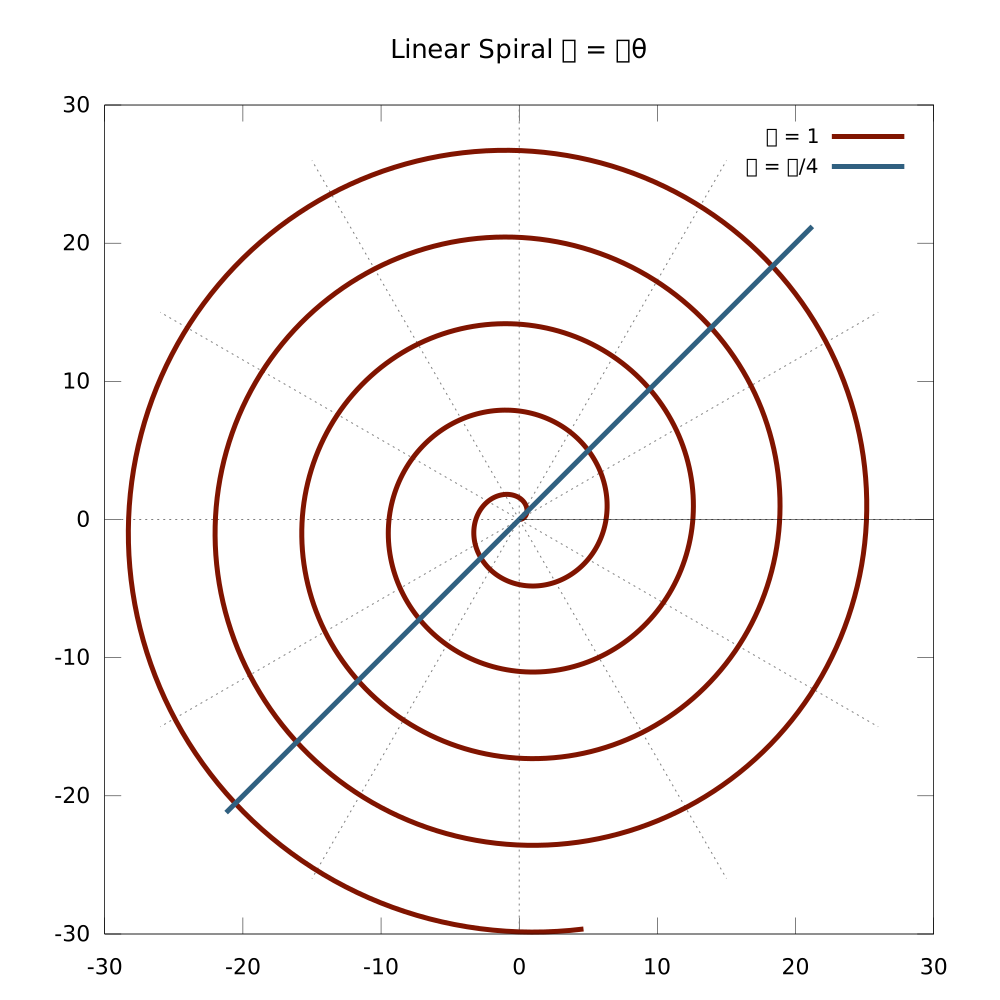
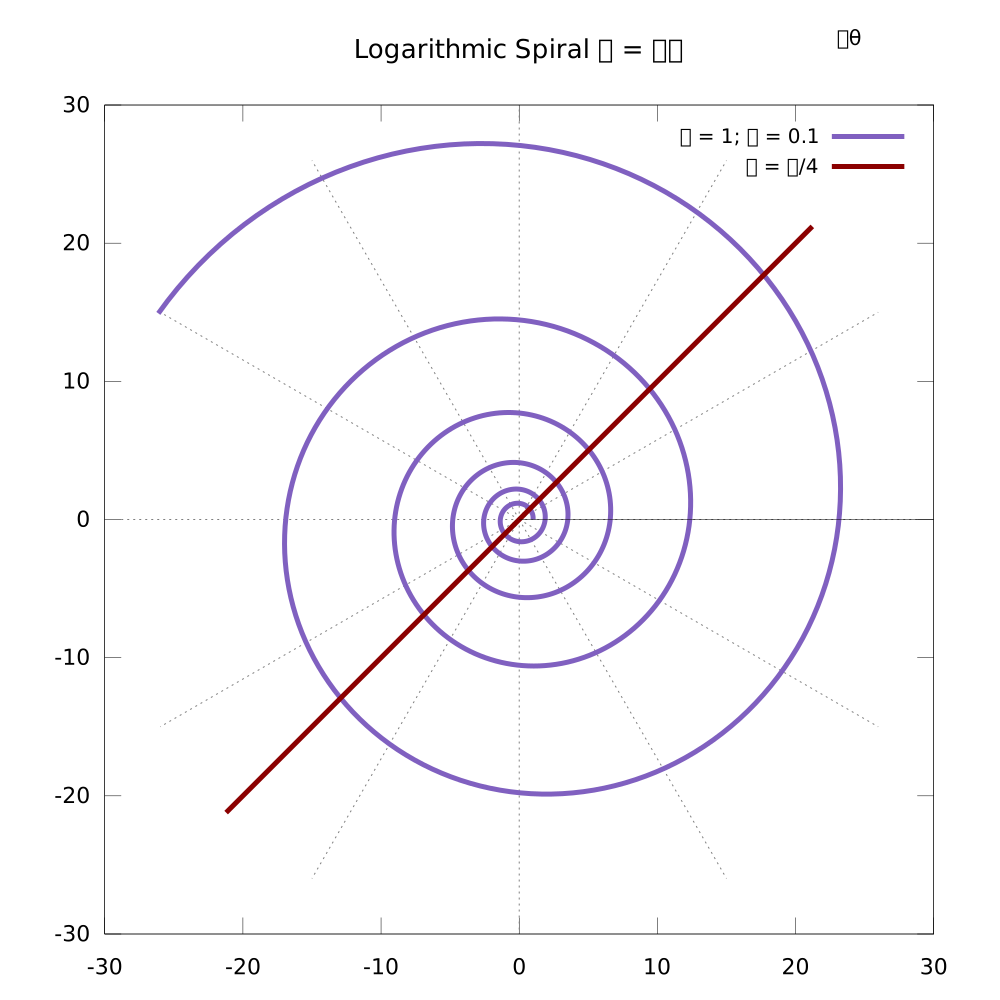
The equations we need to solve are for those values of \(\theta_{n}\) for which line \(\theta = \frac{\pi}{4}\) intersects either \(a\theta\) or \(ae^{k\theta}\), where \(a\) and \(k\) are real constants. As with most things circular, we note that the addition of \(2\pi\) to the value of \(\theta\) is also a valid solution. To start things off, let us simplify variables by assigning \(\theta_0 = \frac{\pi}{4}\).
Let us consider the linear spiral first: \[\begin{aligned} \theta_{n} &= a(\theta_0 + 2\pi n)\; ; \; n\in \mathbb{Z}\\ &= a\theta_0 + 2\pi a n. \end{aligned}\qquad{(20)}\] What is the difference between successive terms? \[\begin{aligned} \theta_{n} - \theta_{n-1} &= a\theta_0 + 2\pi a n - \left[a\theta_0 + 2\pi a(n-1)\right]\\ &= 2\pi a. \end{aligned}\] Thus successive terms differ by a common difference of \(2\pi a\), which is a constant. So, the intersections on the line \(\theta = \frac{\pi}{4} = \theta_0\), are evenly spaced according to an arithmetic progression.
Note that the value of \(\theta_0\) dropped out from the calculations, i.e., the result is independent of the slope of the line that intersects the spiral. We could just as well have used the \(x\)-axis, or the line \(\theta = 0\), and obtained the same result.
Consider now the analogous case for a logarithmic spiral, where we need to bear in mind that both \(a\) and \(k\) are real constants. \[\begin{aligned} \theta_{n} &= ae^{k(\theta_0 + 2\pi n)}\; ; \; n\in \mathbb{Z}\\ &= ae^{(k\theta_0 + 2k\pi n)}\; ; \; n\in \mathbb{Z}\\ &= ae^{k\theta_0}\left[ae^{2k\pi}\right]^n\\ &= Ar^n. \end{aligned}\qquad{(21)}\] where \(A = ae^{k\theta_0}\) and \(r = ae^{2k\pi}\). It is clear that Equation 21 is a GP with first term \(A\) and common ratio \(r\). Again, note that the common ratio is independent of the \(\theta_0\) or the particular straight line we used to derive these results.
The Nautilus Shell
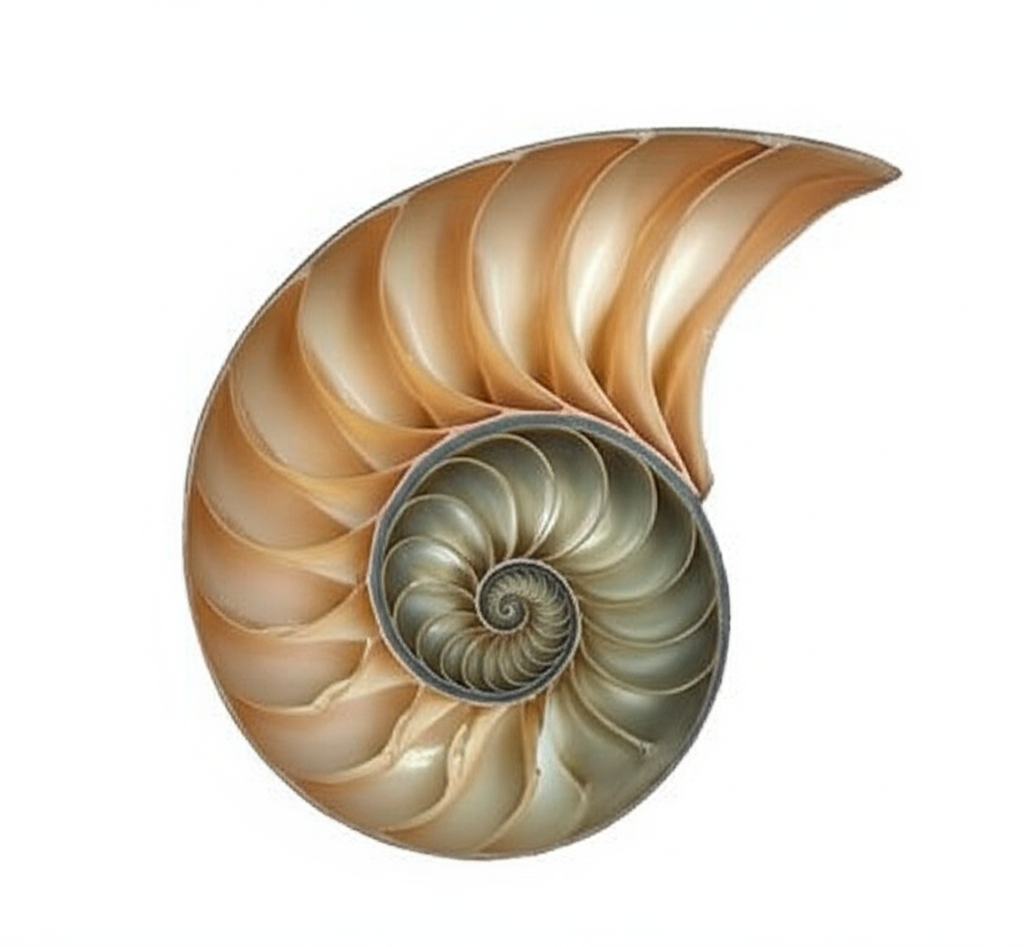
Naturalists have been fascinated by the nautilus shell, illustrated in Figure 9, because of its shape, which follows an almost perfectly formed logarithmic spiral. It is also a record of shape-preserving growth [13–16], because the organism occupying the shell lives and grows with it, changing in size, but not shape.
The exponentials as eigenfunctions
Treating functions as vectors belonging to vector spaces, and considering operations like differentiation as linear transformations leads to insights about the primacy of the complex exponentials for solving linear differential equations with constant coefficients.
If we follow through with this view, we may write, setting \(D = \frac{\mathrm{d}}{\mathrm{d}x}\), and \(\mathbf{v} = e^{ix}\): \[D\mathbf{v} = \frac{\mathrm{d}}{\mathrm{d}x}(e^{ix}) = ie^{ix} = i\mathbf{v} = \lambda\mathbf{v}.\] where \(\lambda\) is a complex scalar. We say that \(\mathbf{v}\) is an eigenvector of the linear transformation \(D\) and \(\lambda\) is an eigenvalue. It is clear that the complex exponential is the eigenfunction for the calculus operations of differentiation and integration.
In my blog Eigenvalues and Eigenvectors—Why are they important? I have pointed out that the exponential functions have a special place in calculus and differential equations because the derivative of a real or complex exponential is a scaled version of the original function.
Linear differential equations with constant coefficients are rife in Nature. The exponentials, because of their eigenfunction property, are the basis of the solutions to these equations. Because the same equations arise again and again in different settings and different disciplines, the exponential functions are fundamentally important in solving these problems.
In engineering, systems that may be described by linear differential equations with constant coefficients, are called linear time-invariant or LTI systems, and the corresponding field of study is called linear systems theory. The real and complex exponentials are the eigenfunctions of these systems and enjoy pride of place because of this property.
Reference Books
Much of the material for these two blogs on \(e\)6 has been drawn from the charmingly written book e: The story of a number by Eli Maor [17]. It makes for delightful reading and is highly recommended, even if you can only afford the time to browse or read randomly. The book by Banks [18] is also highly recommended. The thoughtful and thought-provoking book by K C Cole [19] inspired the section called the power of the exponent in my first blog.
To probe further
Euler did not merely recognize \(e\). He sanctified it as the divine constant of mathematics, where it reigns supreme at the intersection of growth, change, and infinity.
A scholarly—but somewhat leisurely—account of \(e\) may be found in the paper by Coolidge [20]. A more concise history is available at The number e [21]. The biographies of Napier, Euler, the Bernoulli brothers, Gauss and other mathematicians are all accessible from the St. Andrews MacTutor History of Mathematics web site.
To find out more about the nautilus shell, read the classic book On Growth and Form, by Thompson [13] and the one by Cook [14], dedicated to curves.
Most students today do not recognize logarithms as a means of easing the burden of computation—so dependent have we become on calculators. On this topic, I would like to recommend an interesting mathematical/science fiction story by Isaac Asimov called “The Feeling of Power”. It is about a society that has become so dependent on computing machines that it has forgotten how to do arithmetic in the head. The re-discovery of this skill is an act of empowerment. You may read the story online here [22] or here (if you prefer the original look and feel) [23].
To probe even further
Equiangular Spiral. This site does not use the
https://protocol.
Resources on Euler
Biographies
Several excellent biographies on Euler exist. Some have tackled the human side [1, 3]. Others his mathematical contributions [2, 4]. Still others place him in context with other scientists [6]. There is also a somewhat playful comic book that chronicles Euler’s life, including its vicissitudes [24].
YouTube videos
There are many YouTube presentations on the life and accomplishments of Euler. If you are short of time, I recommend watching these two short videos:
Why Leonhard Euler Is the Most Influential Mathematician in History [25] by MigOroEdu. This channel has a several videos on other mathematicians as well.
A (very) Brief History of Leonhard Euler [26] by moderndaymath.
If you have more than an hour to spare, and would like a leisurely but detailed stroll through the life and accomplishments of Euler, take a look at this retrospective on his three hundredth anniversary delivered at an academic colloquium [27].
There is also an interesting YouTube video that stitches together group theory and Euler’s formula, \(e^{\pi i} = -1\) [28]. The videos from 3Blue1Brown are insightful and of high quality, but are usually more demanding.
Acknowledgements
I am indebted to the folks behind the Typst-CeTZ, Matplotlib, and Gnuplot software packages for enabling the plots on this blog. I have also been helped liberally by the following AIs: Claude, Gemini, and ChatGPT. The one note of caution is that one cannot take AI output as correct without due scrutiny. Once an error is detected, one could go through several iterations of corrections with the AI until the results match expectations. The AI, unlike a human being, generally does not complain because it is not fatigued or miffed by its own successive errors.
Feedback
Since I work independently and alone, there is every chance that unintentional mistakes have crept into this blog, due to ignorance or carelessness. Therefore, I especially appreciate your corrective and constructive feedback.
Please email me your comments and corrections.
A PDF version of this article is available for download here:
References
How, in heaven’s name, would one be inspired to write the RHS of this equation? Euler was inspired, and after that he could use the derivation here, or elsewhere, to verify his formula. But is there any substitute for the inspired, intuitive leaps of the imagination that gave rise to the RHS of this equation?↩︎
See my blog A tale of two measures: degrees and radians.↩︎
We compare both curves later, and hope that poor Jakob is not too chagrined by the error made by the engraver of his tombstone.↩︎
Also called the Archimedean spiral.↩︎
A progression is also called a sequence.↩︎
The two blogs are: The Exponential and Logarithmic Functions and e Unleashed.↩︎