Demystifying Fractional Powers
2025-08-24 | 2025-09-06
Estimated Reading Time: 18 minutes
What exactly is √ ?
This question usually pops up in the mind of the earnest student of mathematics after she or he has navigated the slippery slopes of arithmetic. “What! another symbol \(\surd\) that looks strange and tries once more to mystify—and enshroud with the mist of unknowing—my hard won victory over the numbers and symbols of mathematics!” is the anguished refrain.
No wonder there are many who would do anything to escape another encounter with the petrifying subject. They would rather zipline, climb Mount Everest, or bungee jump—at the risk of vertigo, frostbite, or an intestinal accident—than meet mathematics with its dreaded symbols yet again. They have an entrenched fear or dislike, bordering on hatred, for the subject.
So, let us proceed one step at a time and peel, onion-like, the layers of incomprehension that shroud something that is eminently simple and comprehensible. What exactly is a fractional power, such as a square root?
Numbers expressed as sums
Let us start with addition. Suppose we have a whole number, say \(4\), and we want to split it into the sum of other whole numbers. Consider: \[\begin{aligned} 4 &= 4 + (0)\\ &= 3 + 1\\ &= 2 + 2\\ &= 2 + 1 + 1\\ &= 1 + 1 + 1 + 1 \end{aligned}\qquad{(1)}\]
The number \(4\) may be decomposed into a sum of whole numbers in five distinct ways. This is called an integer partition. This is formalized as the partition function in number theory.
We will not discuss this topic any further because it is not central to our exploration, and it too, can get complicated. But it is mentioned here as a warm up exercise for our thought processes on how numbers may be split.
Splitting whole numbers into equal parts
Let us continue with the number \(4\). If we want to split it into two equal parts, we divide \(4\) by \(2\). That is the very meaning of division. So too, if we want to split \(4\) into four equal parts, we divide \(4\) by itself to give \(1\). In general, if we want to split \(4\) into \(n\) equal parts, we divide \(4\) by \(n\). The general expression for an \(n\)-part split of \(4\) is: \[\begin{aligned} 4 &= \frac{4}{n} + \frac{4}{n} + \dots \text{ summed $n$ times, which may also be re-written as}\\ &= \sum_{i}^{n} \left[\frac{4}{n}\right]_i\\ &= \frac{4}{n}\left[ 1 + 1 + \dots \right] \text{ with $n$ ones in the square brackets}\\ &= \frac{4}{n}\sum_{i = 1}^{n} 1. \end{aligned}\qquad{(2)}\]
Note that although we started with whole numbers, the \(n\)-part sum might be composed of rational numbers. For example, if \(n = 3\), we have \[\begin{aligned} 4 &= \frac{4}{3} + \frac{4}{3} + \frac{4}{3}\\ &= \frac{12}{3}\\ &= 4. \end{aligned}\qquad{(3)}\] The three equal fractions are each \(\dfrac{4}{3}\), which is a not a whole number, but rather a rational number.
Extrapolating to real numbers
We have just split whole numbers into \(n\) equal rational parts. Can we extrapolate the above process to real numbers?
Why not? the arithmetic operation of division is defined for real numbers as well.1 So, any real number, \(b\), when split into \(n\) parts becomes: \[b = \frac{b}{n} \sum_{i = 1}^{n} 1.\qquad{(4)}\]
We are now ready to start exploring the real subject of this blog, which is raising a number to a fractional power or fractional exponent.
Notation and assumptions
The base is the number which we will be raising to some power. We will denote it in general by \(b\), bearing in mind that \(b\) is non-zero, and may be a non-zero integer, a non-zero rational number, or a non-zero real number.
Strictly speaking, a fraction may be any rational number, but our attention in this blog is focused on those fractions whose numerator is \(1\). These fractional powers or fractional exponents are denoted by the rational number \(\frac{1}{n}\) where \(n\) is a non-zero integer, not equal to one.2
Care is needed, because we could start with a real number, raise it to a fractional power, and end up with a result that is a complex number.
Meaning of square root
Let us try to split a number into a product rather than a sum of identical numbers. Again, let us start with the number \(4\). We want to split it into the product of two equal numbers. Writing \(4\) as a product,3 we have: \[\begin{aligned} 4 &= 4 \times 1\\ &= 2 \times 2. \end{aligned}\] We might rush to claim that the two equal factors that split \(4\) are \(2\) and \(2\), which is clearly true. But equally true is \(4 = (-2) \times (-2)\). The factorization of \(4\) into two equal factors is not unique.
The symbol we use to denote the two equal factors is \(\surd\). It is called a root or radix and the symbol itself is a stylized letter \(r\).4
By convention the symbol \(\surd\) denotes the positive square root of a number. The negative counterpart must be explicitly stated with a leading minus sign so: \(-\surd\).
Note that the \(\surd\) sign does not have any number \(2\) in it to denote two equal factors. This is simply a convention. You could just as well write \(\sqrt[2]{4} = 2\).
The \(5\)th root
If we wanted to decompose \(4\) into \(5\) equal factors, we could write: \[\begin{aligned} 4 &= \left[\sqrt[5]{4}\right]\left[\sqrt[5]{4}\right]\left[\sqrt[5]{4}\right]\left[\sqrt[5]{4}\right]\left[\sqrt[5]{4}\right]\\ &= 4^\frac{1}{5}\cdot 4^\frac{1}{5}\cdot 4^\frac{1}{5}\cdot 4^\frac{1}{5}\cdot 4^\frac{1}{5} \end{aligned}\] Note that the square brackets and the symbol \(\cdot\) both denote multiplication and that the fifth root is indicated by the fractional exponent \(\frac{1}{5}\).5
In general, when a positive real number \(b\) is split into \(n\) equal factors, we may write: \[\begin{aligned} b &= \left[b^\frac{1}{n}\right]^{n}\\ &= \prod_{i = 1}^n b^\frac{1}{n} \end{aligned}\qquad{(5)}\] Note that Equation 5 is the analogue of Equation 4 in the context of products rather than sums. If you are perceptive, you will realize that division and taking roots are analogous operations for splitting numbers into equal sums or products respectively.
The inadequacy of real numbers alone
But is this the whole story? Unfortunately, not. Fractional exponents arise naturally when we solve polynomial equations with real coefficients. And the real numbers are not sufficient to solve all polynomial equations.
We now carefully navigate our way, single-stepping through different cases, to understand why this is so. Let \(a\) be an arbitrary real number:
The square of zero is zero. \[\begin{aligned} a &= 0 \implies a^2 = 0, \text{ and}\\ a^2 &= 0 \implies a = 0. \end{aligned}\]
The square of a positive number is positive. \[a > 0 \implies a^2 > 0.\]
The square of a negative number is also positive. \[a < 0 \implies a^2 > 0.\]
Therefore, the square of any real number can only be greater than or equal to zero, i.e., \(a^2 \geq 0\). See my blog Varieties of Multiplication for an explanation of why this is so.
If we square a number and then take its square root, we will get back its absolute value.
This means that for an arbitrary real number \(a\): \[\begin{aligned} \sqrt{a^2} &= \lvert a \rvert , \text{ and}\\ \sqrt{(-a)^2} &= \sqrt{a^2}\\ &= \lvert a \rvert.\\ \text{Moreover, }\left[\sqrt{a}\right]^2 &= a, \text{ and}\\ -\left[\sqrt{a}\right]^2 &= -a. \end{aligned}\qquad{(6)}\]
Consider the expression \((x^2 - a^2)\). It may be factorized as \((x - a)(x + a)\). This is called the difference of two squares. To be convinced of this equality we can expand the left hand side (LHS) in Equation 7, and see if we get the right hand side (RHS): \[\begin{aligned} (x - a)(x + a) &= x^2 + ax -ax +(-a)(a)\\ &= x^2 - a^2. \end{aligned}\qquad{(7)}\] But how do we get the two factors, \((x - a)\) and \((x + a)\), in the first place?
To understand this we refer to Equation 6. \[\begin{aligned} x^2 - a^2 &= x^2 - \left[\sqrt{a^2}\right]^2\\ &= (x - \sqrt{a^2})(x + \sqrt{a^2})\\ &= (x - a)(x + a). \end{aligned}\qquad{(8)}\] Equations 7,8 will prove to be useful stepping stones when the going gets slippery.
Now consider the quadratic equation \[x^2 - 1 = 0.\] Following from Equation 7, this may be factorized as: \[\begin{aligned} (x^2 - 1) &= (x^2 - 1^2)\\ &= (x - \sqrt{1^2})(x + \sqrt{1^2})\\ &= (x - 1)(x + 1)\\ &= 0. \end{aligned}\] When a product is zero, either or both of the two factors are zero. So, the solution is \(x = 1\) or \(x = -1\). This much should be old hat.
If the sign of the constant term in the quadratic \(x^2 - 1\) is changed from plus to minus, we get \[x^2 + 1 = 0.\] We want to cast this in the form \(x^2 - a^2\) for some \(a\) to get the difference between two squares.
This means setting \(a^2 = -1\) so that \(x^2 - a^2 = x^2 -(-1) = x^2 + 1\). The difficulty is that the squares of all real numbers are greater than or equal to zero. No real square can ever be negative.6 Nevertheless, let us plough through regardless, and use the square root sign to our advantage.
Let us set \(a^2 = -1\) in Equation 7. We may then write \[\begin{aligned} a^2 &= -1, \text{ or equivalently}\\ a &= \sqrt{-1} \end{aligned}\qquad{(9)}\] without considering whether it makes any sense to us. Invoking Equation 8 we can then progress thus: \[\begin{aligned} x^2 + 1 &= x^2 + 1^2\\ &= x^2 - \left[\sqrt{-1}\right]^2\\ &= (x - \left[\sqrt{-1}\right])(x + \left[\sqrt{-1}\right]). \end{aligned}\] Therefore, \(x = \sqrt{-1}\) or \(x = -\sqrt{-1}\). But these numbers are not real. When they were first encountered, they were considered figments of the imagination and termed imaginary numbers for historical reasons. The name has stuck.
The square root of \(-1\)
The strange number encountered above is \(\sqrt{-1} = (-1)^\frac{1}{2}\). Euler dignified it with a symbol and called it \(i\), the imaginary unit. Once it had a symbol and could be manipulated like other numbers, its “imaginariness” did not present an obstacle. It joined the existing menagerie of numbers as a new member. A real number added to an imaginary number together comprise a complex number.
The set of real numbers is a subset of the set of complex numbers: \(\mathbb{R} \subset \mathbb{C}\).
We may now write the solution to the equation as \[\begin{aligned} x^2 + 1 = 0 &= (x - \sqrt{-1})(x + \sqrt{-1})\\ &= (x - i)(x + i)\\ \end{aligned}\qquad{(10)}\] which leads to the roots \(x = i\) and \(x = -i\) where \(i = \sqrt{-1}\). Without imaginary numbers, we could not solve this equation.
It is clear that fractional roots and complex numbers arise naturally in the solution of polynomial equations with real coefficients. When solving such equations, we need to account for:
roots that are negative as well as positive; and for
roots that are complex as well as purely real.
We therefore need to enlarge and enrich our view of fractional exponents of real numbers.
The Euler formula
Recall the Euler formula, \[e^{i\theta} = \cos\theta + i \sin\theta\qquad{(11)}\] It gives us a means of expressing any real or complex number as a complex exponential.
Because of periodicity, \[e^{i\theta} = e^{i(\theta + 2k\pi)}, \text{ where $k\in \mathbb{Z}$},\] and this equivalence allows us to extract all the roots without exception.
Let us again consider the fractional root of a negative number, other than \((-1)\).
The cube root of \(-8\)
What is the cube root of the number \(-8\)? We know that \((-2)(-2)(-2) = -8\). So, we may answer \(\sqrt[3]{-8} = -2\), and we will not be wrong. But we would have missed out a pair of complex conjugate roots that are also equal to the cube root of \(-8\).
To extract all the roots systematically, we need the formula of Euler, and should proceed as follows:
Write the number whose fractional root we want to extract, as a complex exponential, even if it is a pure real number.
Add \((i2k\pi)\) to the argument of the complex exponential to accommodate all cases.
Apply the law of indices to the complex exponential and extract all the roots.7
Let us apply this algorithm to evaluate \(\sqrt[3]{-8} = (-8)^\frac{1}{3}\):
Observe that if \(-8 = re^{i\theta}\), then \(r = 8\) and \(\theta = \pi\) gives us one equivalence: \(-8 = 8e^{i\pi}\). The rationale for this is as follows: \[\begin{aligned} -8 &= r\left[\cos\theta + i \sin\theta\right]\\ &= 8\left[\cos\theta + i \sin\theta\right]\\ &= 8\left[\cos\pi + i \sin\pi\right] \end{aligned}\] We use that value of \(\theta\) which lies in the interval \(0 \leq \theta < 2\pi\), for which \(\cos\theta = -1\), and \(\sin\theta = 0\). We subsume the negative sign under the cosine function because the \((r, \theta)\) form of the complex number always has a positive \(r\).8
By Euler’s formula, we have \[\begin{aligned} \sqrt[3]{-8} = (-8)^\frac{1}{3} &= \left[8e^{i\pi}\right]^\frac{1}{3}\\ &= 8^\frac{1}{3}\left[e^{i(\pi + 2k\pi)}\right]^\frac{1}{3}\\ &= 2\left[e^\frac{i(2k + 1)\pi}{3} \right] \end{aligned}\qquad{(12)}\]
The cube root of \(-8\) is the root of the polynomial \(x^3 + 8 = 0\), which we expect would have three roots. Moreover, complex roots always occur in conjugate pairs for polynomials with real-valued coefficients.
Is this what Euler’s formula gives us? Let us substitute for \(k\) in Equation 12. For simplicity, we will set \(k\) to be \(0\), \(1\), and \(2\). These three consecutive values of \(k\) should give us our three distinct solutions.9
Let \(\theta\) represent the value \(\frac{(2k + 1)\pi}{3}\). Let us tabulate the roots for different values of \(k\).
| \(𝒌\) | \(𝞱\) | \(𝐜𝐨𝐬\, 𝞱\) | \(𝐬𝐢𝐧\, 𝞱\) | \(𝐫𝐨𝐨𝐭\) |
|---|---|---|---|---|
| 0 | \(\frac{\pi}{3}\) | \(0.5\) | \(\frac{\sqrt{3}}{2}\) | \(1 + i \sqrt{3}\) |
| 1 | \(\frac{3\pi}{3}\) | \(-1\) | \(0\) | \(-2\) |
| 2 | \(\frac{5\pi}{3}\) | \(0.5\) | \(-\frac{\sqrt{3}}{2}\) | \(1 - i \sqrt{3}\) |
We have at last identified the three roots of \((-8)^\frac{1}{3}\) as being:
\(1 + i \sqrt{3}\);
\(-2\); and
\(1 - i \sqrt{3}\).
For those who do not quite believe that the cubes of \(1 + i \sqrt{3}\) and \(1 - i \sqrt{3}\) actually result in \(-8\), do consult this working sheet. All three roots may also be confirmed at Wolfram Alpha.
Illustration on the complex plane
An illustration will help fix in the mind what is going on, especially for visual learners.
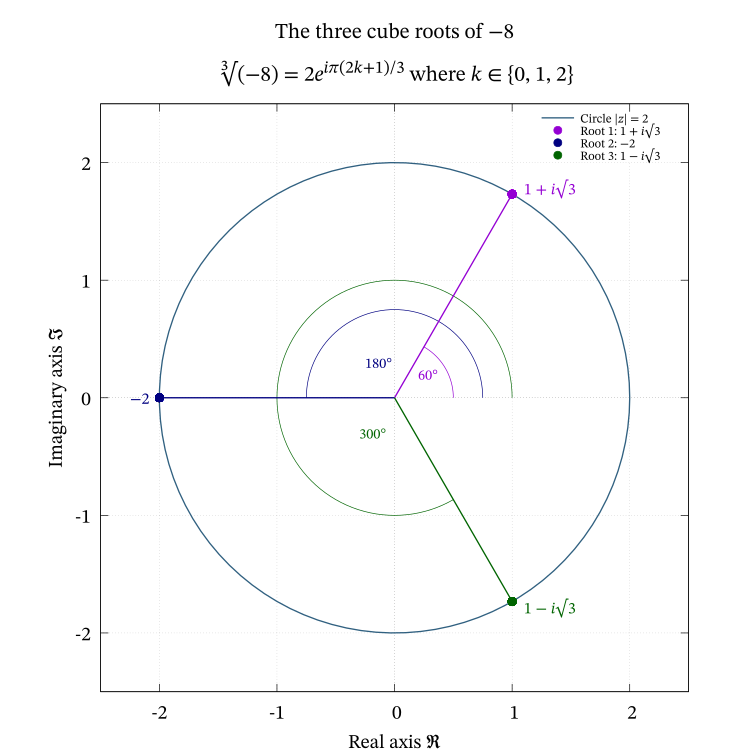
Using the Euler formula, we have already derived the three roots of \(\sqrt[3]{-8}\). But what is the generic reason for the three roots in Figure 1? As stated before, it all boils down to the number of roots of a polynomial of degree \(n\). There are at most \(n\) distinct roots.10 The qualifier “at most” arises because a root may be repeated, and that too, multiple times.11 Bear in mind that the total number of roots of a polynomial of degree \(n\) cannot exceed \(n\).
Another interesting fact is that for even \(n\), the \(n\)th root of a negative integer does not have any real root. For example, \(x^8 + 10 = 0\) will have only complex conjugate pairs of roots and no real roots.
For odd \(n\), though, we will have at least one real root because complex roots always occur in conjugate pairs.
Complex conjugates are reflections of each other on the complex plane along the real axis. In Figure 1 the numbers \(1 + i \sqrt{3} = e^{i\frac{\pi}{3}}\) and \(1 - i \sqrt{3} = e^{i\frac{5\pi}{3}}\) are reflections of each other on the real axis. Note also that the angle \(\frac{5\pi}{3} = -\frac{\pi}{3}\), where a negative angle represents a clockwise rotation whereas a positive angle represents a counter-clockwise rotation about the positive \(x\)-axis.
The roots of unity
Would you believe me if I tell you that not only negative numbers, but positive numbers also, when raised to a fractional power, can yield complex roots? If you shake your head in disbelief, you are not alone. It is astounding, but true, that fractional powers of positive as well as negative numbers can yield complex roots.
This interesting fact was studied by an examination of the fractional roots of the number \(1\) when raised to different fractional powers. The easiest way to understand this is to consider the polynomial \[\begin{aligned} z^n - 1 &= 0, \text{ or equivalently}\\ z^n &= 1 \end{aligned}\qquad{(13)}\] which is sometimes called the cyclotomic equation.12 The roots of this equation are called the roots of unity.13
As stated above, even though \(1\) is a positive real number, its fractional powers can also be complex. To appreciate how this can be so, we follow the same steps as we used to solve for the cube root of \(-8\). We express the number \(1\) in modulus argument form as \((1)e^{i(0 + 2\pi k)} = e^{i(2\pi k)}\) on the Argand diagram or complex plane. The \(n\)th roots of unity satisfy: \[\begin{aligned} z^n &= 1, \text{ which may be re-written as}\\ (z^n)^{\frac{1}{n}} &= 1^{\frac{1}{n}}\\ \text{Substituting $1 = e^{i(2\pi k)}$, we get } z &= \left[e^{i(2\pi k)}\right]^\frac{1}{n}\\ &= e^\frac{i(2\pi k)}{n} \end{aligned}\] It should now be clear that the roots are located on the unit circle and are equally spaced from each other. The angle between successive roots is \(\frac{2\pi}{n}\).
The six sixth roots of unity
The root locations on the unit circle for \(n = 6\) are illustrated in Figure 2.
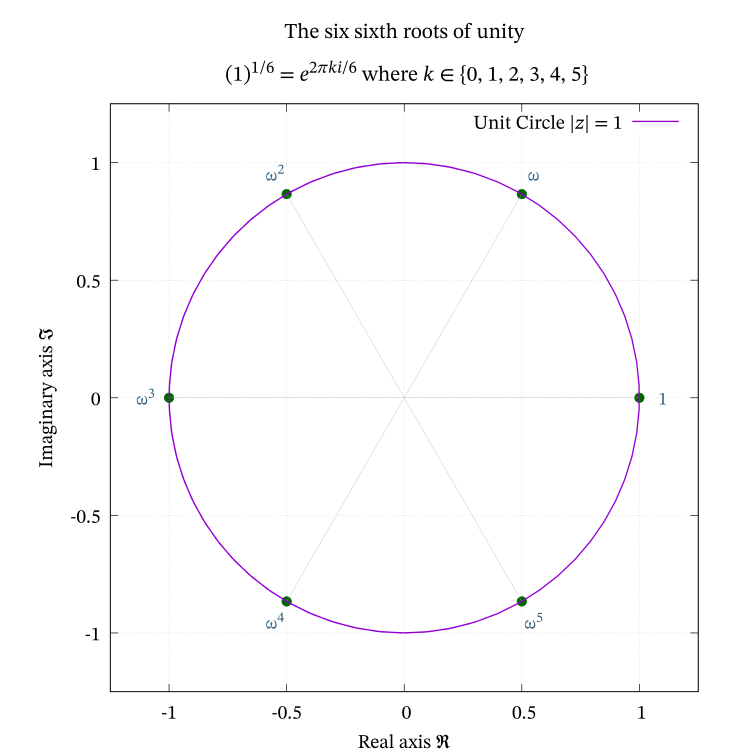
Note that \((1, 0)\) is always a root of unity. The other five roots are arranged symmetrically about the real axis at angles of \(\frac{2\pi}{6} = \frac{\pi}{3} = 60°\). It is customary to denote these roots using the Greek small letter omega written \(\omega\). The first root is \(1\) which may be written as \(\omega^0\). The second root is \(\omega\) which is really \(\omega^1\). So, the roots are all powers of \(\omega\).
What is \(\omega\)? It is a complex number that is one of the sixth roots of unity in this case. The argument of \(\omega\) depends on \(n\) since \(\arg(\omega) = \frac{2\pi}{n}\). In Figure 2, \(\omega\) is \((\frac{1}{2}, \frac{\sqrt{3}}{2})\). Observe that as we progress counter-clockwise from \((1, 0)\), the modulus of all the roots remains at \(1\) but the argument, or angle made with the positive \(x\)-axis, increases by \(\frac{\pi}{3} = 60°\) with each successive root.
When we multiply two complex numbers in polar form, the modulus of the product is the product of the individual moduli, and the argument of the product is the sum of the individual arguments.14 This is how equal angles, when added, show up as an increase in exponent.
| Root | Cartesian Form | Argument |
|---|---|---|
| \(\omega^0\) | \((1, 0)\) | \(0\) |
| \(\omega^1\) | \((\frac{1}{2}, \frac{\sqrt{3}}{2})\) | \(\frac{\pi}{3}\) |
| \(\omega^2\) | \((-\frac{1}{2}, \frac{\sqrt{3}}{2})\) | \(\frac{2\pi}{3}\) |
| \(\omega^3\) | \((-1, 0)\) | \(\frac{3\pi}{3}\) |
| \(\omega^4\) | \((-\frac{1}{2}, -\frac{\sqrt{3}}{2})\) | \(\frac{4\pi}{3}\) |
| \(\omega^5\) | \((\frac{1}{2}, -\frac{\sqrt{3}}{2})\) | \(\frac{5\pi}{3}\) |
How does this relate to the equation \(z^6 = 1\)? We could re-write this equation as \[\begin{aligned} z^6 - 1 &= (z^3 - 1)(z^3 + 1)\\ &= (z − 1)(z^2 + z + 1)(z + 1)(z + 1)(z^2 - z += 1)\\ &= (z - 1)p(z)(z + 1)q(z) \end{aligned}\qquad{(14)}\] The factor \((z - 1)\) is responsible for the root \(\omega^0 = 1\). The factor \((z + 1)\) gives rise to \(\omega^3\). The factor \(p(z)\) contributes to \(\omega^2\) and \(\omega^4\). The factor \(q(z)\) furnishes the roots \(\omega^1 = \omega\) and \(\omega^5\).15
The factors \(p(z)\) and \(q(z)\) above when factored into linear terms will give us \(p(z) = (z - \omega^2)(z - \omega^4)\) and \(q(z) = (z - \omega)(z - \omega^5)\).16
What is the value of \(\omega^6\)? Our original equation was \(z^n = 1\), and since \(\omega\) is a root, and \(n = 6\), it satisfies the equation \(\omega^6 = 1\).
Observe that each root that is one position counter-clockwise to the one before it, is \(\omega\) times that previous root. One position counter-clockwise to the root \(\omega^5\) is therefore \(\omega^6\) but that is also the value \(\omega^0 = 1\). Again, therefore, \(\omega^6 = 1 = \omega^0\).17
Some properties of the \(n\)th roots of unity
The roots of unity possess interesting properties of geometry, symmetry, etc., that have singled them out for special study by mathematicians.
The number \(1\) is always a root of unity. The first root after \(1\) is the primitive root \(\omega\), and every other root may be generated by multiplying \(\omega\) by itself. Again, since the other roots are all powers of \(\omega\), this should not be a surprise.
Consider the sequence of roots, moving from the number \(1\), around the full circle counter-clockwise. The sequence of roots is \(1, \omega, \omega^2, \omega^3, \dots \omega^{n-1}\). This is a geometric progression, or geometric sequence, with first term \(a = 1\) and common ratio \(r = \omega\). The sum of the first \(n\) terms of this sequence is: \[\begin{aligned} S_n &= 1 + \omega + \omega^2 + \dots + \omega^{(n-1)}\\ &= \frac{a(r^n - 1)}{r - 1}\\ &= \frac{a(\omega^n - 1)}{\omega - 1}, \text{ but we know from above that $\omega^n = 1$}\\ &= \frac{a(0)}{\omega - 1}, \text{ since the denominator $(\omega - 1)$ cannot be zero}\\ &= 0. \end{aligned}\qquad{(15)}\] Thus the sum of the \(n\)th roots of unity is always zero, independent of the value of \(n\).
The arguments18 of the roots are in an arithmetic progression while the roots themselves are in a geometric progression. This is a useful property and finds use in the context of proving or solving certain types of mathematical problems.
Applications of the roots of unity
The roots of unity find applications in both pure and applied mathematics. While we cannot go into those applications in any depth here—because many of these are advanced topics requiring non-trivial pre-requisites—it is worth listing them to whet your appetite to explore them further, according to your need.
Geometry and Regular Polygons
The \(n\)th roots of unity, when plotted on the complex plane, form the vertices of a regular \(n\)-sided polygon inscribed within the unit circle. Consequently, they help us construct regular polygons, and this provides a powerful connection between algebra and geometry. For example, the third roots of unity form an equilateral triangle, and the sixth roots of unity form a hexagon as will be apparent from Figure 1 and Figure 2 respectively.
Solving Polynomial Equations
The roots of unity allow us to solve equations of the form \(z^n = a\), not just for positive real numbers, but for any complex number \(a\), thus generalizing the idea of a fractional exponent. The solutions are found by first finding the \(n\)th root of the modulus of \(a\) and then using the roots of unity to find the \(n\) distinct angular positions of the solutions on the complex plane.
The roots of unity are the roots of the polynomial \(z^n - 1 = 0\). This means that they can be used to factor this polynomial into a product of linear terms.
Trigonometry and Complex Numbers
The roots of unity—especially through their connection to Euler’s formula and De Moivre’s Theorem—are a powerful tool for exploring, deriving, and simplifying trigonometric identities.
Number Theory and Galois Theory
The roots of unity are central to the study of cyclotomic fields and their associated Galois groups. These are highly significant in algebraic number theory. For example, Gauss used the theory of cyclotomic fields to prove the constructibility of the regular heptadecagon (17-gon) with a compass and straightedge [1].19
Group Theory
The \(n\)th roots of unity form a cyclic group under multiplication, which is a fundamental concept in abstract algebra. This provides a concrete and intuitive example of a finite cyclic group. See my blog The Two Most Important Numbers: Zero and One.
Discrete and Fast Fourier Transforms
In signal processing, the roots of unity are the fundamental building blocks of the Discrete Fourier Transform (DFT), a cornerstone algorithm used to decompose a signal into its constituent frequencies. The DFT’s efficiency, especially in its faster form—the Fast Fourier Transform or FFT—relies heavily on the properties of the roots of unity.
Epilogue
It is incredible how a simple question about the square root symbol and an exploration of fractional exponentials has led us through a spellbinding journey of discovery, and ultimately opened the vistas of advanced mathematics. Who would have guessed that the cube root of \(-8\) would have one real and two complex roots? Or that \(z^6 - 1\) would have roots that are multiples of \(\omega\) and \(\omega^5\)? Mathematics can be engrossing and endlessly fascinating as long as we are bold and patient enough to engage with it. The rewards are enormous and often totally unexpected.
Acknowledgements
The usual thanks to the various AIs and Wolfram Alpha for helping check the results.
Feedback
Please email me your comments and corrections.
A PDF version of this article is available for download here:
References
As long as the divisor or denominator is non-zero.↩︎
Since a base raised to the power \(1\) leaves the base unchanged, the tacit assumption is that \(n\) is also not one.↩︎
Because real multiplication is commutative, we do not list transposed factors.↩︎
Even as the integral sign \(\int\) is stylized letter \(s\).↩︎
See my blogs Varieties of Multiplication and The Two Most Important Numbers: Zero and One if you find this notation unfamiliar.↩︎
See also my blog Expressions, Equations, and Formulae.↩︎
This method will yield both real and complex roots.↩︎
See A Tetrad of Captivating Problems if you are unclear about this.↩︎
If you are curious, you may try other values, including negative integers, to see if you get the same results. Given the periodic nature of the trigonometric functions, you will find that the roots repeat themselves. For three distinct roots, we need three distinct values of \(k\) that have three different remainders when divided by three. Three consecutive integers fit this bill.↩︎
See the Fundamental Theorem of Algebra.↩︎
This is, not surprisingly, called the multiplicity of the root.↩︎
Cyclotomic means “circle cutting” in Greek and this meaning will become pellucid as the concept unfolds. The variable \(z\) is used to emphasize that the roots are complex.↩︎
This topic is usually taught in pure mathematics courses in the final year of high school, but if you missed it, here is a chance to get acquainted with the idea.↩︎
See my previous blog A Tetrad of Captivating Problems if this seems unfamiliar.↩︎
The roots from \(q(z)\) are called the primitive roots of unity for \(n = 6\), but we will not discuss that here.↩︎
Try to verify this for yourself.↩︎
Think of it as an old-fashioned rotary mechanical switch.↩︎
Meaning the angles of the complex numbers.↩︎
Gauss wanted a headstone with a regular heptadecagon to commemorate his discovery, but unfortunately his desire was not fulfilled [1].↩︎