Service as a Spiritual Practice
2020-06-06 | 2026-06-11
Estimated Reading Time: 20 minutes
Spiritual practices
A spiritual practice is any deliberate and oft-repeated action performed by a person to better express and experience his or her spiritual nature. Attending a place of worship, going on a pilgrimage, doing charity, fasting, fulfilling vows, feeding a hungry person, meditating, participating in group singing of hymns, practising stoicism, all come under the umbrella of spiritual practices. By their very nature, spiritual practices are varied and often dictated by tradition, or by individual taste and temperament.
This blog is about service to fellow beings as a spiritual practice in light of Sanātana Dharma, sometimes less accurately termed Hinduism [1].
Spiritual Practices as Simulations
In the beginning, all spiritual practices are merely simulations. When a person has perfected any spiritual practice, the simulation becomes the real thing, and the accompanying state—of body, mind, and soul—is attained.
Sādhana—to give spiritual practice its Sanskrit name—is performed in the belief that it speeds up our awakening from the common, stupendous delusion called māyā, the illusory web that so holds us in its unyielding thrall, that we are asleep to Reality even when wide awake.
In the beginning, all spiritual practices are merely simulations.
From effect to cause
If sādhana is mere simulation, then
Why do we do it?
And how is it effective?
The answer to the first question is self-evident in Shakespeare’s Hamlet (Act III, Scene 4): “Assume a virtue, if you have it not.”
The answer to the second question is best appreciated by a thought-experiment. Suppose that we were already liberated from māyā—the cosmic hypnosis common to us all. We would then be spontaneously engaged in certain actions—of body, mind, and soul—as a natural accompaniment to our liberated state. Liberation is the cause and the actions that accompany it are the effect.
Spiritual practices are those actions that we would be engaged in spontaneously were we already liberated. We perform them in the hope that—in converse fashion—we thereby attain the state that automatically accompanies them.
In sādhana, we simulate the effect to generate the cause. This is the single unifying principle underlying all spiritual practices.
Sādhana is therefore the solution of an inverse problem. If you are familiar with chemistry, think of it as a reversible reaction: one that can proceed in either direction depending on the relative concentrations of the reacting chemicals and their products.
While the inverse problem model offers a plausible explanation for practicing sādhana, its deeper justification lies further still. Were sādhana not effective, it could not have survived for centuries across cultures, geographies, spiritual traditions, and beliefs as a sensible use of humankind’s time on Earth. Sādhana just works.
Mahāvākyas, Affirmations, Autosuggestion
Simulating the effect to generate the cause would perplex the logic of the unconvinced. In this short digression, specific examples are offered for those of a sceptical turn of mind.
The four Vedas–which are at least 3,500 years old—contain four Mahāvākyas [2] or “great utterances” about the nature of ultimate Reality. There is a time-honoured traditional practice, or sādhana, of repeating and internalizing each of these utterances until it becomes the subjective reality of the practitioner.
For example, one of the Mahāvākyas is aham brahmāsmi, or “I am Brahman (the Supreme Being).” Note that the utterance is in present tense, as if already affirming a truth, even if the practitioner is just starting out, and therefore only simulating it at first.
The same principle is applied when affirmations like “I am whole, I am well,” are repeated for healing [3]. The famous suggestion, “Every day in every way, I am getting better and better,” of Emile Coué, [4, p 49] is yet another example of simulating the effect to generate the cause.
Once we agree that sādhana is both sensible and effective, the next question is what types of sādhana should we do? Meditation is one that easily comes to mind.
Meditation
Meditation is a close cousin of sleep. The reason meditation is primus inter pares (first among equals) in spiritual practices is that it leads directly to an altered state of consciousness, just like sleep.
However, the meditative state is not attained as easily as the sleep state is.1 But practice makes perfect. We are able to fall asleep every night throughout our lives because we have practised doing so, and find it a commonplace act. So too, relentless practice of meditation makes that state (seem) easily attainable.2
Once one masters reaching the state of somnolence or hypnagogia [5] without falling asleep—and without losing consciousness—one will find the signposts that lead to real meditation rather than a simulation. But it might take years or lifetimes to achieve this, and even then, the entry to the actual meditative state might be ephemeral and tantalizing. Yet, as with any fine craft, deliberate repetition is the path to proficiency. The trajectory from apprentice to master passes through the state of the journeyman.
Transcending māyā
Einstein is reputed to have said that a problem cannot be solved at the level at which it arose. An analogy will help to make this statement less mystifying.
Think of an ant crawling across a table following a scent-trail. It is able to see only what is close to it on the table at any time: this is the two-dimensional view that an ant has. The destination at the other end of the table is not visible until the ant is close to it.
Now consider a human being whose vision has the advantage of three rather than two spatial dimensions. Unlike the ant, such an observer is able to see not only the ant but also its destination in one go. This is possible because the level of apprehension, or viewpoint, has changed to permit it.
To defeat or circumvent māyā, we have to make an effort to access a state of consciousness that is not within māyā. That sounds tautological until you realize that—in meditation—we are merely simulating that state, until magically one day, it actually materializes.
Therefore, to transcend māyā, we have to alter our state of consciousness. We use meditation to simulate this shift until it actually happens, and we finally transcend māyā.
Stillness and meditation
The human body is designed to move. All advice on exercise, walking, keeping fit, etc., recognizes this fact. In sleep, mobility is reduced to turning and tossing at most. The meditative state involves even greater stillness; possibly total immobility. So, generally, a person cannot remain meditative for more than a few hours every day.3
Moreover, unless someone is in a monastery or other cloistered environment, the need for food and water make earning a living an existential imperative. And that involves moving rather than being still.
So, we need another spiritual practice—which we can perform while we actively go about our duties—that functions as the second engine of spiritual growth, with meditation as the first. And that second engine is service as a spiritual practice. While meditation exemplifies spirituality in stillness, service expresses spirituality in action. Such balance is a foundational principle of Sanātana Dharma.
Service
The Sanskrit term for service is seva. When our awareness is identified with the body and its attachments, we are in the state of “I, Me, Mine”, otherwise called the ego. The entire purpose of seva as sādhana is to transcend the ego and naturally glide into the awareness of our real soul nature wherein the unholy triad of “I, Me, Mine” cannot enter. When service is entrained as sādhana, the whole goal is simply this transcendence, which has been identified even outside the spiritual arena.
Flow
Athletes, writers, and many others are aware of a state wherein they seem to be in auto-pilot, almost witnessing their own actions, as they go about doing effortlessly what they set out to do. This state has been called flow [6] or Zen or transcendence, or some such term. It is like a runner’s high. Or like the scientist approaching the eureka moment, when like a scent-led-bloodhound, she/he indefatigably pursues the quest whose end is sensed to be near.
Egoless activity is spiritual service
This state of flow is the state of egoless activity, and it arises because the confining shackles of “I, Me, Mine” have been removed. The state of a soul—unchained from the ego and beyond māyā—is likewise efficient and effortless in the performance of action. This is the goal. Alas, flow is not available on tap and is often the reward for relentless diligence and practice.
The Bhagavad Gītā
Occurring on a battlefield, the Bhagavad Gītā is a discourse between Lord Krishna and Prince Arjuna, who is overcome by despondency and an unwillingness to fight when confronted by the opposing army. Mind you, Arjuna is an expert archer and a seasoned, battle-hardened veteran. It was not cowardice, but the horrendous prospect of slaughtering in battle his own kinsmen and teachers, who were arrayed in opposition, that induced Arjuna’s reluctance to take up arms.
The advice given by Lord Krishna in this dramatic setting is a premier guiding light for the way of life called Sanātana Dharma.
While only a handful of the seven hundred verses in the Bhagavad Gītā touch upon meditation as a specific spiritual practice, it is spiritualized action or service that is analyzed threadbare in the vast majority of its verses. Hence, the Bhagavad Gītā is our manual par excellence for service as a spiritual practice.
Injunctions on spiritual service
The Bhagavad Gītā is very clear on how to transmute ordinary actions into service as a spiritual activity. It prescribes four pillars on which spiritualized actions should rest. These are:
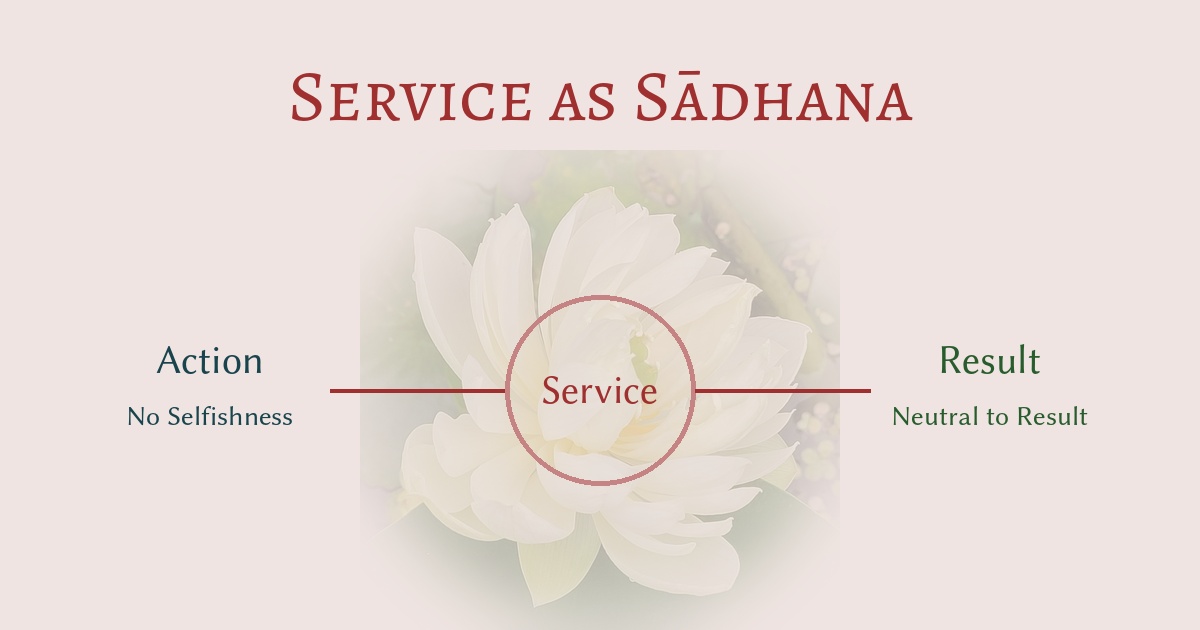
Absence of personal, selfish motive for the action
Neutrality toward the result of the action
An attitude of sacrifice when performing the action
An attitude that serving others is serving oneself
These prescriptions arise because that is the way a person who has transcended māyā actually acts. Again, using the inverse problem model, we are admonished to act in the same way, even if it is initially only a simulation, so that in the end, we may ourselves transcend māyā. These four pillars leave little or no room for “I, Me, Mine” to enter either.
No selfish motive
Generally, we act selfishly. To act without selfishness (and also without foolishness!) requires skill. That is why Lord Krishna says in the Bhagavad Gītā (2:50) that:
yogaḥ karmasu kauśalam ।
Yoga is skill in action.
Acting without selfishness breaks the chain of cause and effect, also known as the Law of Karma. If the practice of meditation requires skill, so too does the practice of spiritual service.
Abiding by the first pillar removes the “I, Me, Mine” directly as the service is not being done for personal gain or aggrandisement. Accordingly, there is no magnet of personal interest in the action to attract the iron filings of karma to it.
An unselfish act is not lackadaisical. It is done with diligent interest, but without selfish motive as in “involved detachment”. In his commentary on Chapter IV, Verse 18, of the Bhagavad Gītā, Paramahansa Yogananda explains it as “subjective aloofness” coupled with “objective enthusiasm”:
He who can thus act for God with subjective aloofness, and yet retain objective enthusiasm in activity for the sake of pleasing God and not for satisfying his own desires, is a true yogi. Knowing that the purpose of all human activities is to get back to God, the yogi looks for His guiding hand in everything, knowing too well the ego’s propensity for “putting its foot” in the wrong places! Thus the yogi plays in this drama of life without resorting to individual egotistical desires and without succumbing to a dejected aloofness (laziness or indifference); in this way he fulfils his spiritual duty to please the Cosmic Dramatist, God.4 [7]
A demanding prescription indeed—but one that transforms the very ground of action.
Neutrality to the result
If an action fails, one is discouraged. If an action succeeds, one is exhilarated. But we are counselled neither to be discouraged nor to be elated, regardless of the outcome of our action: another difficult prescription.
Once again, this admonition is designed to snap the binding chain of karma. Intelligent, unselfish, indefatigable activity approximates spiritual service. Detachment from results also removes the stress related to anxiety about outcomes, allowing for relaxed, efficient, and effective action.
I have tried to depict diagrammatically, with some licence, the first two prescriptions in Figure 1.
The Bhagavad Gītā (2:47) explicitly counsels:
karmaṇy-eva adhikāraste mā phaleṣu kadācana ।
mā karma phalaheturbhūr mā te sangostv-akarmaṇi ॥
You have jurisdiction or control only over the action and never with its fruits;
and further, never become inactive just because you are detached from the results of action.
The first two pillars are designed to leave little or no room for “I, Me, Mine” in the act of spiritual service.
The last two pillars of spiritual service are really injections of devotion and wisdom into action to spiritualize it even more. Let us look at them in turn.
The notion of sacrifice: action colored by devotion
Sacrifice is an act of worship in most religions; in Sanātana Dharma it occupies a central place, and is called yajña. Sacrifice can range from the pouring of oblations into a sacrificial fire, to fasting, to tithing, to esoteric meditation techniques, to mentally bequeathing all activity to the Supreme Being.
The Vedas and Upaniṣads aver that creation itself was born out of sacrifice. They identify the interdependence of the other (non-physical) worlds, or dimensions of existence, with our physical world through sacrifice as the conduit of communication. For example, the fire sacrifice was carried by smoke to the other worlds.
The Mahānārayaṇa Upaniṣad (79:11) [8] says this about sacrifice:
yajñe sarvaṃ pratiṣṭhitaṃ ।
tasmādyajñaṃ paramaṃ vadanti ॥
Everything is supported by sacrifice.
Therefore, they say sacrifice is the supreme means of liberation.
A profound refinement of the nature of sacrifice occurs in the Bhagavad Gītā, where external sacrifice is internalized—as an oblation of breath into breath, of surrendering every action as an offering to the Divine, etc. Outer sacrifice has been internalized into inner oblation. This deep change of perspective is at the root of selfless action as a path to the Divine, karma yoga, as promulgated by the Bhagavad Gītā.
This very memorable Bhagavad Gītā verse (4:24) is oft-repeated before meals are commenced, much like Grace is said in the West:
brahmārpaṇaṁ brahma havirbrahmāgnau brahmaṇā hutam ।
brahmaiva tena gantavyaṁ brahmakarma samādhinā ॥
The act of offering is Brahman, the oblation is Brahman, offered by Brahman into the fire of Brahman.
Brahman alone is reached by one who is absorbed in Brahman-action.
Note that the supreme Brahman encompasses and enfolds sacrifice in its entirety leaving no scope for duality.
In verse (3:15), the Bhagavad Gītā says:
tasmātsarvagataṃ brahma nityam yajne pratiṣṭhitam
Therefore, the all-pervading, eternal Brahman (Supreme Being), is always established in sacrifice.
Elsewhere, the Bhagavad Gītā (9:27) counsels
yad karoṣi yadaśnāsi yajjuhosi dadāsi yat ।
yat tapasyasi kaunteya tat kuruṣva madarpaṇam ॥
Whatever you do, whatever you eat, whatever you offer as an oblation, whatever you donate,
whatever austerity you practice, O son of Kunti, do that as an offering to Me.
With the heart’s devotion, one may transmute all activity—not only those actions performed explicitly as spiritual service—into sacrifice, and therefore into liberating action.
In the words dadāsi yat the Bhagavad Gītā draws attention to the act of giving. Charity is not simply a casual and supercilious “I give you because you are less fortunate” gesture. It is a holy sacrificial act, yajña, in which the divinity of the giver, the accepter, and the act of giving are all honoured; and this triad is ultimately fused in the unity of the omnipresent Self.
There is a famous book, The Practice of the Presence of God, [9] written by a humble, French Carmelite monk, Brother Lawrence, who lived in the seventeenth century, in which he documents his literal practice of the exhortation of this Bhagavad Gītā verse (9:27), which ultimately led to his own enlightenment. So this prescription just works.5
Wisdom’s vision: seeing oneself in all
When describing the Supreme Being, knowable by meditation, Lord Krishna uses the unequivocal phrase hṛdī sarvasya viṣṭhitam (13:18) meaning “seated in all hearts”. A sage does not narrowly identify with a physical body or mind, but rather views all creation as the extension of the Self. Her/his wisdom-gaze sees only that Supreme Being everywhere.
The kinship so experienced means seeing one’s Self in all and as all. Mark that this is not sympathy or empathy but identity. Again, we solve the inverse problem by assuming this virtue of the wisdom-gaze, and hopefully, the realization of the same will one day dawn upon us.
For a philosophical exploration of this profundity, see my blog, The Dearness Code.
Swami Sivananda on Service
The twentieth century sage, Swami Sivananda, who founded the Divine Life Society, put it thus:
There is no physical world for me. What I see I see as the glorious manifestation of the Almighty. I rejoice when I behold the Purusha with thousands of heads and thousands of eyes and feet, that Sahasrasirsha Purusha. When I serve persons, I see not the persons, but Him of whom they are the limbs. I learn to be humble before the mighty Being whose breath we breathe and whose joy we enjoy. I do not think there is anything more to teach or to learn. Here is the cream of religion, the quintessence of philosophy that anyone really needs…
To behold the Lord in every being or form, to feel Him everywhere, at all times and in all conditions of life, to see, hear, taste and feel everything as God, is my creed.
To live in God, to melt in God, and to dissolve in God, is my creed.
By dwelling in such union, to utilise the hands, mind, senses and the body in the service of humanity, to sing the Names of the Lord, to elevate devotees, to give instructions to sincere aspirants, and disseminate knowledge throughout the world, is my creed, if you can call it one.
To be a cosmic friend and cosmic benefactor, a friend of the poor, the forlorn, the helpless and the fallen, is my creed.
It is my sacred creed to serve the sick, to nurse them with care, sympathy and love, to cheer up the depressed, to infuse power and joy in all, to feel oneness with each and everyone, and to treat all with equal vision.
In my highest creed there are neither peasants nor kings, neither beggars nor emperors, neither males nor females, neither teachers nor students. I love to live, move and have my being in this realm indescribable [10].
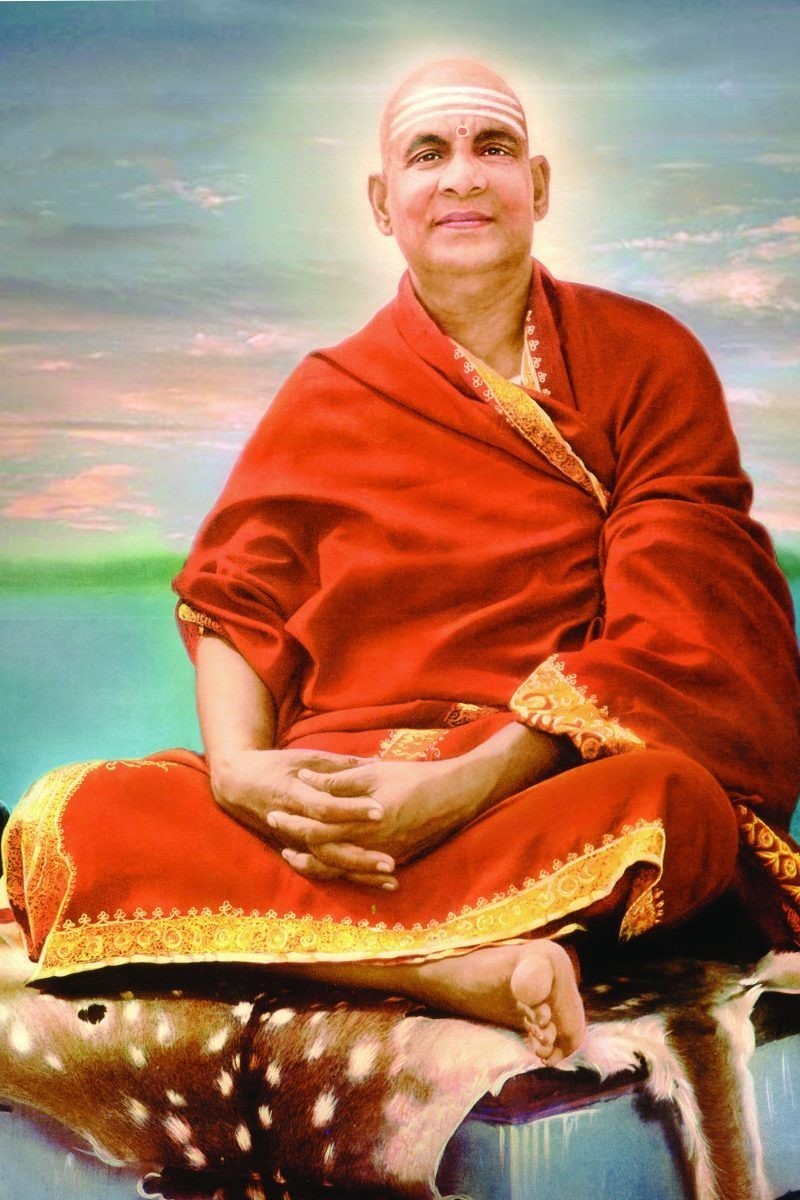
Swami Sivananda demonstrated through his life what spiritual service is, and his munificence was such that he was humorously addressed as Swami “Givananda”. The spontaneous service that he demonstrated is initially simulated by us in the hope that we too can achieve that grand realization of “seeing, loving, and serving the Self in all.”
Ultimately, there are no others to serve; only one’s Self, seen in all.
To recapitulate, if I see my Self in you, I will serve you most joyously because I am serving myself reflected to me as you. And herein lies the kernel of truth that makes service such a potent spiritual activity. It simulates in the practice the state being aimed for, à la Shakespeare.
The Secret Sauce
For service to be efficient, effective, and spiritually redemptive, we need to be grounded in the four pillars:
Shed the impulsion of personal gain.
Accept all outcomes with equanimity.
Perform actions as sacrifice.
Serve all as your own Self.
We simulate service at first and actually serve in the end. There is no place for “I, Me, Mine”. The cause-effect chain is broken when we so act. Service is spiritual dynamite which breaks the rocks of the effects of bad karma from all incarnations past. In service, attitude transmutes a mundane action into a spiritually liberating one.
Practical hints
The spiritual aspirant seeking to serve others, thinking that it would be an easy way to liberation, would be in for a rude shock. He or she would often receive brutal ego-crushing experiences, and should have the mental fortitude to withstand them unshaken. Let me illustrate with a simple example.
Suppose a devotee serves by washing dishes at a hermitage. It might sound like a cosy task in a secluded niche, away from the hurly-burly of direct human contact. But the moment someone at the hermitage gives a searing adverse comment on the quality of the dishwashing, there would be a provocation to retort. Reacting thus would negate the spiritual merit of the service. Ideally, the devotee should thank the detractor, and continue to wash dishes with equanimity, and without rancour. This spiritually mature “non-response” requires humility and patience in large measure.
In fact, a whole catalogue of virtues may be cultivated through service as sādhana. Humility, patience, forbearance, courage, equanimity, kindness, consideration, courtesy, empathy, reciprocity, sincerity, unflappability, and a host of allied virtues are necessary prerequisites for success in spiritual service. Just as a perfect sculpture is sanded and polished countless times, these virtues must be practised patiently until they become second nature.
Even small acts of kindness like lending a sympathetic ear to someone’s grief, or directing a lost person so that he or she finds the way, are acts of spiritual service, if done with the right attitude. Ultimately, this confers the realization that there are no others: service to others is only service to one’s Self.
Finally …
Any activity done as an offering to the Supreme Being who dwells within all is considered yajña, which has the power to unshackle us from our past karma, and allow us to rest in our own true form: the omnipresent Self. How is this transformation accomplished? By altering our focus from the narrow world of ‘I, me, mine’ to the singular, expansive reality of “God! God! God!”6 [11].
Feedback
Please email me your comments and corrections.
A PDF version of this article is available for download here:
References
Alas, some people have trouble even falling asleep.↩︎
The refreshment from sleep is immediate, whereas meditation usually yields its fruits only after some effort, and possibly struggle. Sleep is like a savings account—deposits accumulate and withdrawals are immediate. Meditation is more like a pension: contributions must be made patiently over years before the income flows freely and without effort.↩︎
This does not apply to adepts in the art of meditation who have mastered bodily imperatives.↩︎
Italics are mine.↩︎
No claims are made that Brother Lawrence knew of or had read the Bhagavad Gītā. He simply lived his life in light of what this verse prescribes.↩︎
Read as “Omnipresent Supreme Being” if you are allergic to the term “God”!↩︎